Udyam Registration for MSMEs: Benefits, Process and Documents
Starting a business comes with many questions. Which registration is needed? Which one can be done later? Which registration actually helps the business? Many new business owners hear about Udyam but are not sure whether it is useful or just another formality.
This guide explains its meaning, eligibility, benefits, required details, and registration process in simple language.
Quick summary
- Udyam is the official MSME registration for businesses in India.
- It helps eligible businesses get MSME recognition and access related benefits.
- Registration is free and can be completed online through the official government portal.
- It can support loan applications, delayed payment protection, tender eligibility, and scheme benefits.
- It does not replace GST registration, trade licence, FSSAI licence, or other business-specific licences.
- New business owners should apply once basic details like business name, activity, address, PAN, and bank details are ready.
What Is Udyam?
Udyam is the official government registration system for recognizing a business as an MSME (Micro, Small, or Medium Enterprise) in India.
Earlier, businesses used Udyog Aadhaar for MSME recognition. That system was later replaced with Udyam. After successful registration, the business gets a Udyam certificate. This certificate includes a unique registration number and basic business details. It can be used as proof of MSME status when applying for loans, tenders, schemes, and other forms of business support. The process is online and can be completed through the official government portal free of charge.
Is It Useful for Someone Planning to Start a Business?
Yes, it can be useful, but only when you have the basic business details ready. If you are only thinking about a business idea, you may not need to register immediately. But if you have started operations or are ready with details such as business name, address, activity, PAN, bank account, and date of commencement, then getting MSME registration can help. It is especially useful if you plan to:
- Apply for a business loan
- Sell goods or services to larger companies
- Bid for government tenders
- Claim MSME-related schemes or subsidies
- Share MSME proof with banks, buyers, government portals, and scheme platforms when required
- Protect your business against delayed payments, where applicable
Once registration is done, keeping invoices and payment records organized is equally important. Businesses can use mazu to create GST-compliant invoices, quotations, and payment records. Where applicable, they can also create e-way bills and e-invoices, and share documents with customers through WhatsApp or email.
Who is Eligible to Apply for Udyam?
Any eligible business that falls within the MSME classification limits can apply for Udyam Registration. The classification is based on two factors: investment in plant, machinery, or equipment and annual turnover. Current MSME limits are:
| Category | Investment Limit | Annual Turnover Limit |
|---|---|---|
| Micro | Up to ₹2.5 crore | Up to ₹10 crore |
| Small | Up to ₹25 crore | Up to ₹100 crore |
| Medium | Up to ₹125 crore | Up to ₹500 crore |
Category
Investment Limit
Annual Turnover Limit
Category
Investment Limit
Annual Turnover Limit
Category
Investment Limit
Annual Turnover Limit
Both conditions are checked together. For example, if a business falls within the investment limit but crosses the turnover limit, its category may change.
Eligible business types may include sole proprietorships, partnership firms, LLPs, private limited companies, Hindu Undivided Families, cooperatives, trusts, manufacturing businesses, service businesses, and trading businesses.
Retail and wholesale traders can register on the Udyam portal. However, their MSME benefits are mainly linked to Priority Sector Lending, as per official guidelines. Overall, the business should select the correct activity and provide accurate details while applying.
Udyam Registration Benefits
Udyam registration gives a business official proof of its MSME status. This proof can be useful in different situations, especially when dealing with banks, buyers, government portals, and scheme applications. However, the benefits are not automatic. The business must still meet the required eligibility rules.
1. Easier Documentation for Loans
Banks and financial institutions often request MSME details when reviewing business loan applications. Having a registration certificate can make this documentation easier.
Eligible micro and small enterprises may also apply for credit guarantee support under schemes such as CGTMSE. However, registration does not guarantee loan approval. Lenders still check the business profile, repayment capacity, documents, and scheme eligibility.
2. Support in Delayed Payment Cases
Delayed payments can affect cash flow, especially for small businesses. Registered micro and small enterprises may raise delayed payment complaints through the MSME Samadhaan portal, subject to applicable rules. This can be useful when a buyer delays payment beyond the allowed period and the business wants to formally raise the issue.
3. Useful for Tenders and Buyer Verification
Some tenders, government schemes, and large buyers may ask for proof of MSME status. In such cases, the Udyam certificate helps the business show that it is registered as an MSME. This does not guarantee government orders or buyer approval, but it helps complete the documentation where MSME proof is required.
4. Helps While Applying for MSME Schemes
Central and state governments may offer MSME schemes for areas such as technology upgrades, quality certification, market access, trade fairs, and business development. The exact benefit depends on the scheme, business type, location, and eligibility rules. The registration certificate is often one of the documents required while applying.
5. Gives Formal Identity to a New Business
For a new business, formal documentation matters. A registration certificate gives the business a recognized MSME identity that can be used in official processes when required.
Documents and Details Required for Udyam
The process is mostly based on self-declaration and online verification. In most cases, the applicant does not need to upload many documents.
Note that GST registration is not compulsory for every business. If your business is not required to register under the GST law, you can still apply without a GSTIN. Keep the following details ready before applying:
- Aadhaar number of the proprietor, managing partner, karta, or authorized person, as applicable
- PAN of the proprietor or business entity
- GSTIN, if applicable
- Business name
- Type of organisation
- Business address
- Date of commencement
- Bank account number and IFSC code
- Main business activity
- NIC code
- Number of employees
- Investment details
- Turnover details
How to Complete the Udyam Registration Process
Step 1: Visit the Official Portal
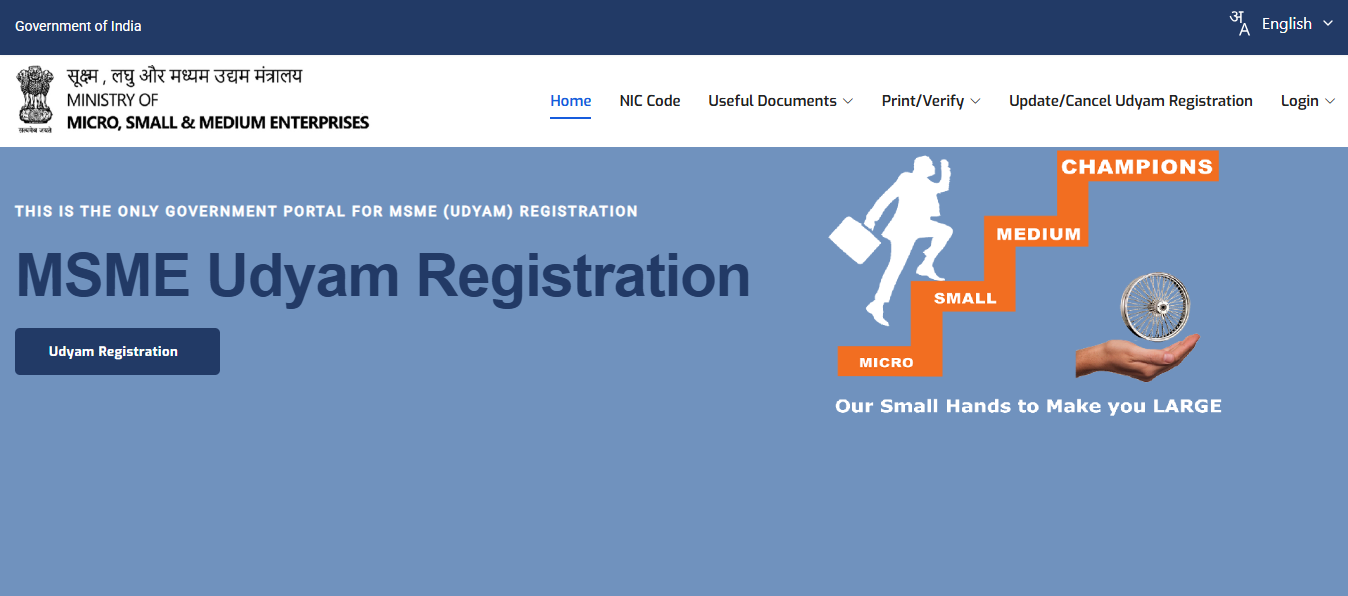
Go to the official Udyam government portal to register. Avoid paid third-party websites unless you knowingly want help from a service provider. Many private websites look similar but charge a fee for a process that can be done directly on the government portal.
Step 2: Choose the Correct Option
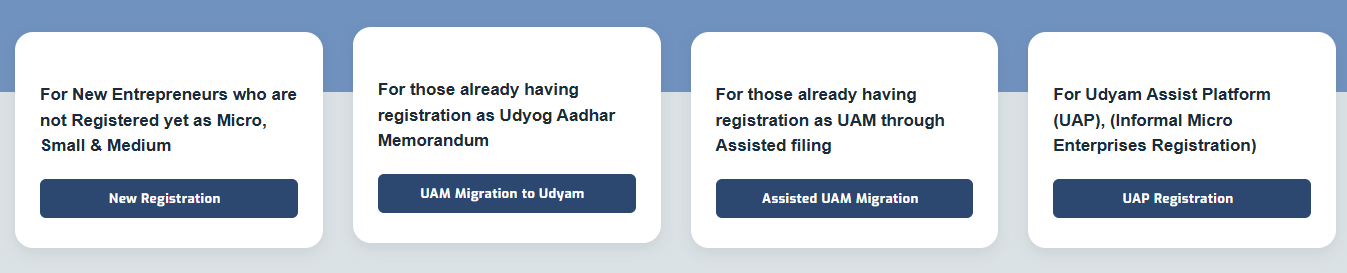
If your business is new and not registered as an MSME, choose the option for new entrepreneurs. If you already have an older Udyog Aadhaar registration, choose the option meant for existing UAM holders or migration, if applicable.
Step 3: Enter Aadhaar Details
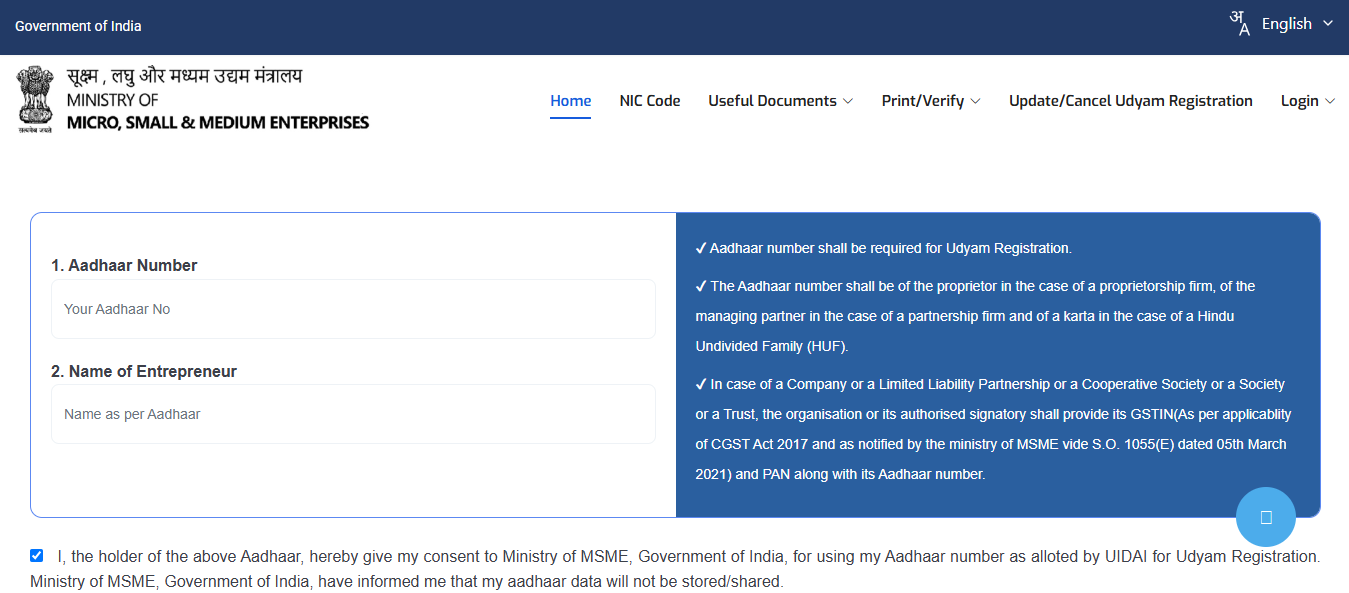
Enter the required Aadhaar details. The OTP will be sent to the mobile number linked with Aadhaar. After OTP verification, you can move to the next step.
Step 4: Complete PAN Verification
Enter the PAN details of the proprietor or business entity, depending on the type of organisation. For companies and LLPs, business PAN and other linked details may be verified through government databases.
Step 5: Add Business Information
Fill in the required business details using the information you have already kept ready, such as business name, address, activity, bank details, employee count, investment, and turnover. Choose the business activity and NIC code carefully, as incorrect details may cause issues later when applying for schemes or loans, or when updating records.
Step 6: Submit the Application
After checking all details, submit the form. Once the application is processed, the business gets its registration number and certificate online. Save the certificate because it may be needed for loans, tenders, schemes, or buyer verification.
Things to Know Before Applying for Udyam
It Is Free on the Official Portal
The government registration process is free. If someone asks you to pay, check whether they are a private agent or consultant.
It Does Not Replace Other Registrations
This registration gives MSME recognition. It does not replace GST registration, FSSAI licence, trade licence, professional tax registration, Shops and Establishments registration, or any other licence required for your business. For example, a bakery may still need FSSAI registration. A shop may still need a local trade licence. A business crossing the GST threshold may still need GST registration.
One Business Should Have One Registration
A business should not create multiple Udyam registrations for the same enterprise. If the business has more than one activity, those activities can be added under the same registration. If details change, the existing record should be updated.
No Regular Renewal Is Required
The Udyam certificate does not require regular renewal. However, businesses should update their details on the portal if there are any changes to their address, activity, bank details, investment, turnover, or business structure. This helps keep the registration record accurate and avoids mismatch issues later.
Conclusion
Udyam registration is useful for many small and growing businesses in India. It helps a business qualify as an MSME and can support loan applications, delayed-payment protection, government tender benefits, and scheme eligibility.
For someone planning to start a business, it is not the first step at the idea stage. But once basic business details are ready, completing the registration can make future banking, compliance, and buyer interactions smoother.
The process is free and available online on the official portal. The key is to enter accurate details and remember that this registration supports your business but does not replace other licenses or automatically guarantee every benefit.