Proforma Invoice Meaning, Format and When to Use It
When you start a business, invoicing can feel confusing. You may already know about bills, receipts, tax invoices, and GST invoices. Then a customer asks for a proforma invoice, and it may not be clear what they need.
A proforma invoice helps you share order details before the buyer confirms the transaction. It sets expectations around price, items, taxes, payment terms, and delivery details.
Quick summary
- A proforma invoice is a preliminary document sent before the final sale is confirmed.
- It helps the buyer understand the expected price, items, taxes, payment terms, and delivery timeline.
- It is commonly used for exports, custom orders, advance payments, project work, and bulk inquiries.
- A proforma invoice is not a tax invoice and does not become a payment demand on its own.
- A proforma invoice cannot be used to claim GST input tax credit.
This guide explains what a proforma invoice is, when to use it, what it should include, how it differs from a tax invoice, and how to create a simple proforma invoice format for your business.
What Is a Proforma Invoice?
A proforma invoice is a preliminary bill sent to a buyer before goods are supplied or services are completed. It is useful when the buyer needs a formal document to approve the order, arrange advance payment, or confirm the expected cost. In simple terms, it tells the buyer what the order may include, how much it may cost, and what terms they need to confirm before moving ahead.
A proforma invoice is not the final bill. Once the supply takes place, you need to issue the correct tax invoice as per applicable invoicing rules.
Invoice vs Proforma Invoice: Key Differences
A proforma invoice often looks similar to a tax invoice, but both documents serve different purposes.
| Point of Difference | Proforma Invoice | Tax Invoice |
|---|---|---|
| Purpose | Confirms expected price and terms before the sale | Records an actual supply |
| When it is issued | Before goods or services are supplied | When the supply takes place or within the time allowed under the GST rules |
| Payment obligation | Does not create a payment obligation on its own | Used as an official invoice for records and payment |
| GST use | Not treated as a GST tax invoice | Used for GST records and return filing |
| Input tax credit | Cannot be used to claim ITC | Can be used to claim ITC if other GST conditions are met |
| Numbering | Should have a separate proforma series | Should follow the tax invoice numbering series |
Point of Difference
Proforma Invoice
Tax Invoice
Point of Difference
Proforma Invoice
Tax Invoice
Point of Difference
Proforma Invoice
Tax Invoice
Point of Difference
Proforma Invoice
Tax Invoice
Point of Difference
Proforma Invoice
Tax Invoice
Point of Difference
Proforma Invoice
Tax Invoice
When Should You Send a Proforma Invoice?
1. Export and International Trade
Proforma invoices are commonly used before export orders are confirmed. The buyer, bank, or logistics partner may ask for one to understand the expected item details, shipment value, payment terms, and delivery terms.
However, a proforma invoice does not replace the documents required for actual export clearance. Depending on the transaction, export documentation may still require documents such as a commercial invoice cum packing list, shipping bill, airway bill, or bill of lading.
For example, if you are exporting garments, machine parts, handicrafts, or food products, you may send a proforma invoice first so the buyer can confirm the order or arrange advance payment. Once the shipment is finalized, the required export documents and final invoice should be prepared separately.
2. Custom Orders or Made-to-Order Products
If you sell custom products, you may need written confirmation before production starts. This is common for branded merchandise, furniture, packaging material, uniforms, printed items, or customised equipment.
A proforma invoice helps you confirm the item details, quantity, price, advance amount, and delivery timeline before you commit resources. This reduces the chances of disputes if the buyer later changes the order or delays payment.
3. Advance Payment Requests
Many small businesses ask for advance payment before starting work, producing goods, or dispatching an order. A proforma invoice provides the buyer with a document they can use for internal approval or payment processing.
If you are registered for GST and receive an advance, check whether a receipt voucher or another GST document is required. GST treatment may differ for goods and services, so record the advance properly and issue the correct tax invoice when required.
4. Project-Based Work
Service providers, freelancers, consultants, and agencies can use proforma invoices before starting a project. It helps confirm the scope, cost, payment terms, and expected timeline. For example, if you are offering design work, website development, repair services, consulting, or installation work, a proforma invoice can clarify the terms before work begins.
5. Bulk Enquiries
If a buyer requests a large quantity of products, a simple verbal quote may not be sufficient. A proforma invoice provides them with item-wise costs, taxes, and terms. This is helpful for wholesalers, distributors, traders, manufacturers, and suppliers who regularly handle bulk orders.
What Should a Proforma Invoice Include?
A proforma invoice should give the buyer enough information to review the order, confirm the terms, and process approval or advance payment where needed. Include these details:
| Detail | What to Mention |
|---|---|
| Business name, address, and contact details | Add your company name, address, phone number, and email ID. |
| GSTIN, if applicable | If your business is registered under GST, mention your GSTIN. |
| Document title | Clearly write “Proforma Invoice” at the top of the document. |
| Proforma invoice number | Use a separate numbering series, such as PI-001 or PRO-001. Do not mix it with your tax invoice series. |
| Date of issue | Mention the date on which the proforma invoice is issued. |
| Buyer details | Add the buyer’s name, business name, address, and GSTIN, if applicable. |
| Item or service details | Mention the item name, service description, quantity, unit, rate, and total amount. |
| HSN/SAC code, if applicable | Add HSN for goods or SAC for services, especially if you are mentioning GST details. |
| Tax details | Mention CGST, SGST, or IGST where applicable. Since this is not a tax invoice, these amounts are only for estimation and confirmation. |
| Total amount | Show the final amount clearly so the buyer knows the expected payable value. |
| Currency | Mention the currency clearly, especially for export orders or international buyers. |
| Payment terms | Mention whether payment is advance, partial, full, or due before dispatch. |
| Validity period | Mention how long the price and terms are valid, such as 15 days or 30 days. |
| Expected delivery or completion date | Add a delivery timeline or estimated completion date. |
| Bank details | Add bank details if you are requesting advance payment. |
| Proforma invoice note | Add a note such as: “This is a Proforma Invoice and not a Tax Invoice. GST input tax credit cannot be claimed on this document.” |
Detail
What to Mention
Detail
What to Mention
Detail
What to Mention
Detail
What to Mention
Detail
What to Mention
Detail
What to Mention
Detail
What to Mention
Detail
What to Mention
Detail
What to Mention
Detail
What to Mention
Detail
What to Mention
Detail
What to Mention
Detail
What to Mention
Detail
What to Mention
Detail
What to Mention
Detail
What to Mention
Proforma Invoice Format
Here is a simple proforma invoice format you can adapt for your business.
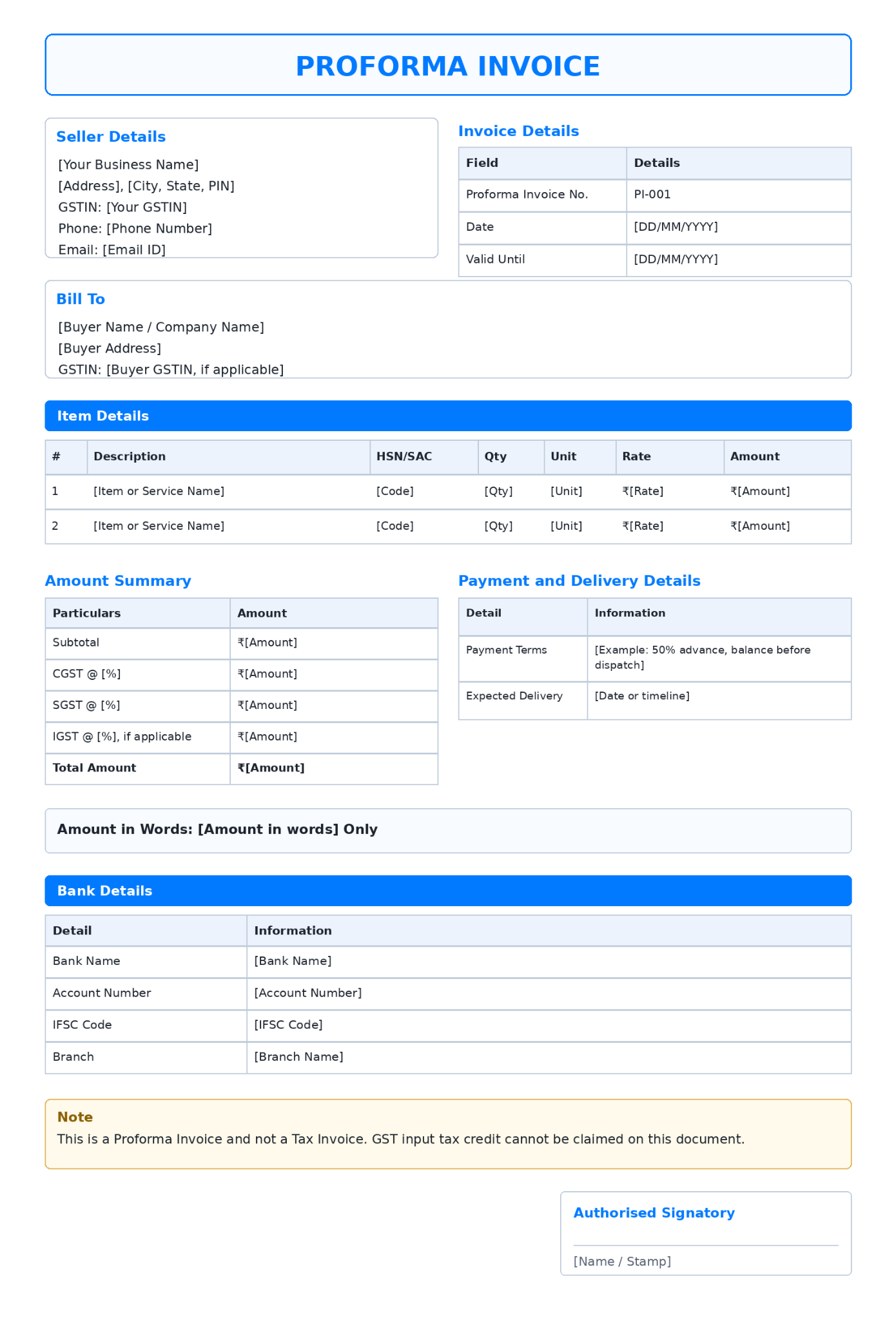
If you do not want to create billing documents manually every time, mazu helps you create clean invoices, share them with customers, and keep your billing records organised from your phone.
Common Mistakes to Avoid
1. Treating a Proforma Invoice as a Final Invoice
A proforma invoice is not the final bill and should not be used as a tax invoice. Once goods are supplied or services are completed, issue the correct tax invoice as per applicable GST invoicing rules.
2. Not Labelling the Document Clearly
Always mention “Proforma Invoice” at the top. If the document is not labelled clearly, the buyer may confuse it with a tax invoice, especially when GST and total amount are shown.
3. Using the Same Number Series as Tax Invoices
Keep a separate series for proforma invoices. For example, use PI-001, PI-002, and PI-003 for proforma invoices. Use your regular invoice series only for actual tax invoices.
4. Not Mentioning Validity and Payment Terms
Prices, delivery timelines, and payment terms can change. Mention the validity period clearly, such as 15 days or 30 days. If you need advance payment, mention the exact terms, such as “50% advance and 50% before dispatch.”
5. Not Recording Advance Payments Properly
A proforma invoice itself is not recorded as a final sale. However, if you receive advance payment against it, record the payment properly in your books and issue the required document as per applicable rules.
Conclusion
A proforma invoice helps you confirm order details before the final invoice is issued. It is useful when the buyer needs a formal document for approval, advance payment, exports, custom orders, project work, or bulk enquiries.
For new business owners, it keeps communication clear before the sale is completed. Once the supply takes place, do not treat the proforma invoice as the final GST invoice. Issue the correct tax invoice as per applicable invoicing rules.