Invoice Format for Small Businesses: Fields, Example, and Template
Most small business owners send invoices, but many invoices miss important details. Some do not have a due date. Some have vague item descriptions. Some do not clearly show GST details. These small gaps can delay payments and lead to repeated follow-ups.
A clear invoice format helps you avoid these problems. It tells the buyer what they purchased, how much they need to pay, when they need to pay, and how they can make the payment.
Quick summary
- An invoice is a formal document you send to a customer to request payment for goods or services.
- A proper invoice format includes the seller's details, buyer's details, invoice number, item details, tax details, payment terms, and bank details.
- If you are registered under GST, your tax invoice should include the required GST details, where applicable.
- Incomplete invoices can delay payments, create buyer confusion, and cause GST compliance issues.
- A clear invoice helps buyers approve payments faster and gives you a cleaner record for follow-ups, GST filing, and accounting.
This guide explains regular invoices and GST tax invoices for small businesses. If you are a composition dealer, selling exempt goods or services, or are unsure about your GST status, check whether you need a Tax Invoice, Bill of Supply, or another GST document.
What Is an Invoice?
An invoice is a document issued by a seller to a buyer to request payment for goods supplied or services provided. It records what was sold, the amount payable, and the payment due date.
If you are registered under GST, your invoice may also work as a tax document. Your buyer may use it to claim Input Tax Credit, so the invoice should include the required GST details.
Even if you are not registered under GST, a clear invoice is still important. It helps the buyer process your payment faster and gives you a proper record for accounting.
Invoice vs Related Documents: Quick Difference
Before understanding the invoice format, it helps to know how an invoice is different from other business documents.
| Document | When It Is Sent | Purpose |
|---|---|---|
| Quotation | Before the sale | To share price and terms with the buyer |
| Proforma Invoice | Before delivery or final billing | To confirm order details or request advance payment |
| Tax Invoice | For goods, before or at the time of removal or delivery. For services, within the prescribed GST timeline. | To request payment and record taxable supply |
| Bill of Supply | For composition dealers or exempt supplies | To record supply where GST is not charged |
| Receipt | After payment is received | To confirm that payment has been made |
Document
When It Is Sent
Purpose
Document
When It Is Sent
Purpose
Document
When It Is Sent
Purpose
Document
When It Is Sent
Purpose
Document
When It Is Sent
Purpose
An invoice formally requests payment. A receipt confirms that payment has already been received.
Invoice Format for Small Business: Template
Here is a simple invoice format you can use as a reference while creating your own invoice.
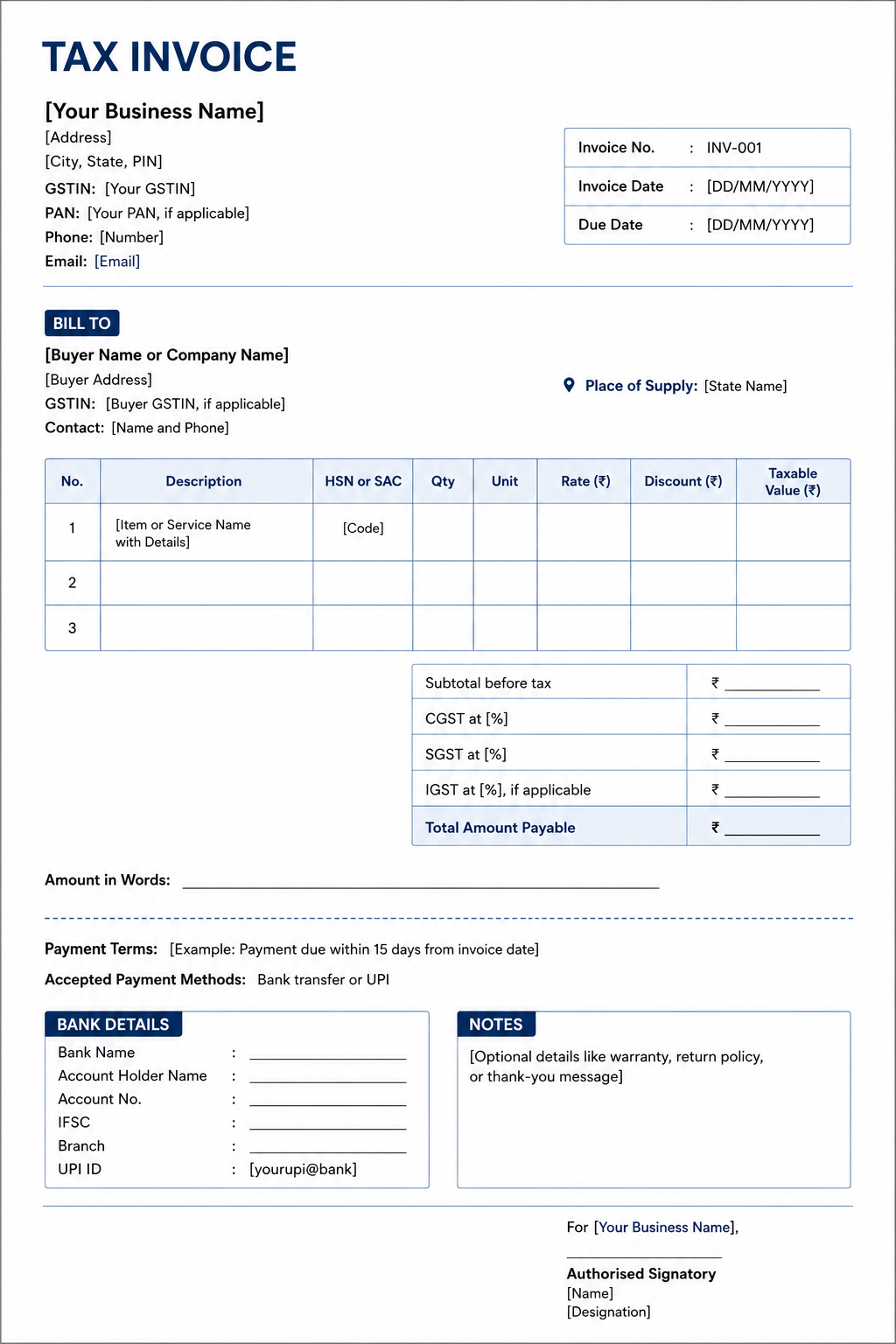
The image above shows how a basic small business invoice can be structured. Below, each field is explained in simple terms, so you know what to add and why it matters.
Invoice Format for Small Business: Key Fields Explained
1. Document Title
The document title should clearly show what type of document it is. Use Tax Invoice if you are registered under GST and charging GST. Use Bill of Supply if you are a composition dealer or making exempt supplies. If you are not registered under GST, a regular Invoice is enough.
This helps the buyer understand whether GST is being charged and what type of document they have received.
2. Your Business Details
Add your business details at the top of the invoice. Make sure your business name and GSTIN, if applicable, match your registration details. Wrong details can create problems during payment processing or GST checks.
- Business name
- Complete business address
- GSTIN, if registered under GST
- PAN number, if required by the buyer or transaction
- Phone number
- Email address
3. Invoice Number
Every invoice should have a unique invoice number, such as INV-001, INV-002, or FY26-27-001.
For GST invoices, the invoice number should follow a proper series within the financial year. Do not repeat invoice numbers. A clear invoice number helps you track payments, returns, credit notes, debit notes, and accounting entries.
4. Invoice Date
The invoice date is the date on which the invoice is issued. Under GST, the timing for issuing a tax invoice depends on the type of supply. For goods, the invoice is generally issued before or at the time of supply, depending on whether the goods are moved or delivered. For services, it is generally issued within 30 days from the date of supply.
Certain service providers, such as banks, insurers, financial institutions, and NBFCs, may have a 45-day timeline. For small businesses, the simple rule is this: create the invoice on time and avoid delayed billing.
5. Buyer’s Details
Add the buyer’s details clearly and make sure to include:
- Buyer’s name or company name
- Buyer’s address
- Buyer’s GSTIN for B2B tax invoices
- Contact person and phone number, if available
For B2C sales, the buyer’s GSTIN is not required. However, for taxable supplies of ₹50,000 or more to an unregistered buyer, GST rules may require the buyer’s name, address, delivery address, state, and state code. Add these details whenever applicable or when the buyer asks for them.
6. Place of Supply
Place of supply is important under GST because it helps decide whether CGST and SGST apply or IGST applies. For example, if your business is in Delhi and the place of supply is also Delhi, CGST and SGST may apply. If the place of supply is Maharashtra, IGST may apply.
Check the buyer’s state, delivery address, and supply details before applying tax. Getting this wrong can create GST reporting issues.
7. Item Description Table
The item table is the main part of the invoice. It should clearly show what was sold. For each product or service, include:
- Item or service name
- Short description
- HSN code for goods or SAC code for services, where applicable
- Quantity
- Unit of measurement
- Rate per unit
- Discount, if any
- Taxable value
Avoid vague descriptions like “miscellaneous items” or “professional work.” A clear description helps the buyer match the invoice with the order, service period, or work approval.
8. GST Breakdown
If GST applies, show the tax clearly. For supply within the same state, mention CGST and SGST separately. For supply between different states, mention IGST. Also mention the tax rate and tax amount separately. Do not combine all taxes into one unclear line. Clear tax details help with GST filing, reconciliation, and buyer records.
9. Total Amount Payable
The invoice should show the final amount payable after adding taxes and deducting discounts. Also write the amount in words, such as “Rupees Twenty-Three Thousand Six Hundred Only”. Writing the amount in words helps avoid confusion over the final payment amount.
10. Payment Due Date
A due date indicates when payment is expected. Instead of only writing “payment due in 15 days,” mention the exact date wherever possible to make follow ups easier and reduce payment delays. For example: Due by 15 August 2026
11. Payment Terms
Payment terms explain how the buyer should pay and what conditions apply. You can mention accepted payment methods, late payment terms, or any early payment discount.
12. Bank Details
Add the bank name, account holder name, account number, IFSC code, and branch name so the buyer can pay without asking for details again. If you accept UPI, mention your UPI ID or add a QR code. This gives the buyer a quicker payment option and can help reduce payment delays.
13. Notes or Special Instructions
This is an optional section. You can use it for warranty terms, return policy, delivery notes, or a short thank-you message. Keep it brief and useful. Do not add too many unrelated instructions here.
14. Authorised Signatory
Add the name, designation, and signature of the authorised person. The signature can be physical or digital. For GST invoices, the invoice should be signed by the supplier or an authorised person.
GST invoice details can vary based on your registration type, supply type, invoice value, and latest GST rules. If you are unsure about any field, confirm it with your CA or tax advisor before sending the invoice.
Creating invoices manually may work when you are just starting out. But as orders grow, it becomes harder to track which invoices are sent, which payments are pending, and which customers need follow-up.
With mazu, small businesses can create GST-ready invoices, track payment status, and keep billing records in one place. It helps you manage invoices without complicating the process.
Sample Invoice with GST Calculation
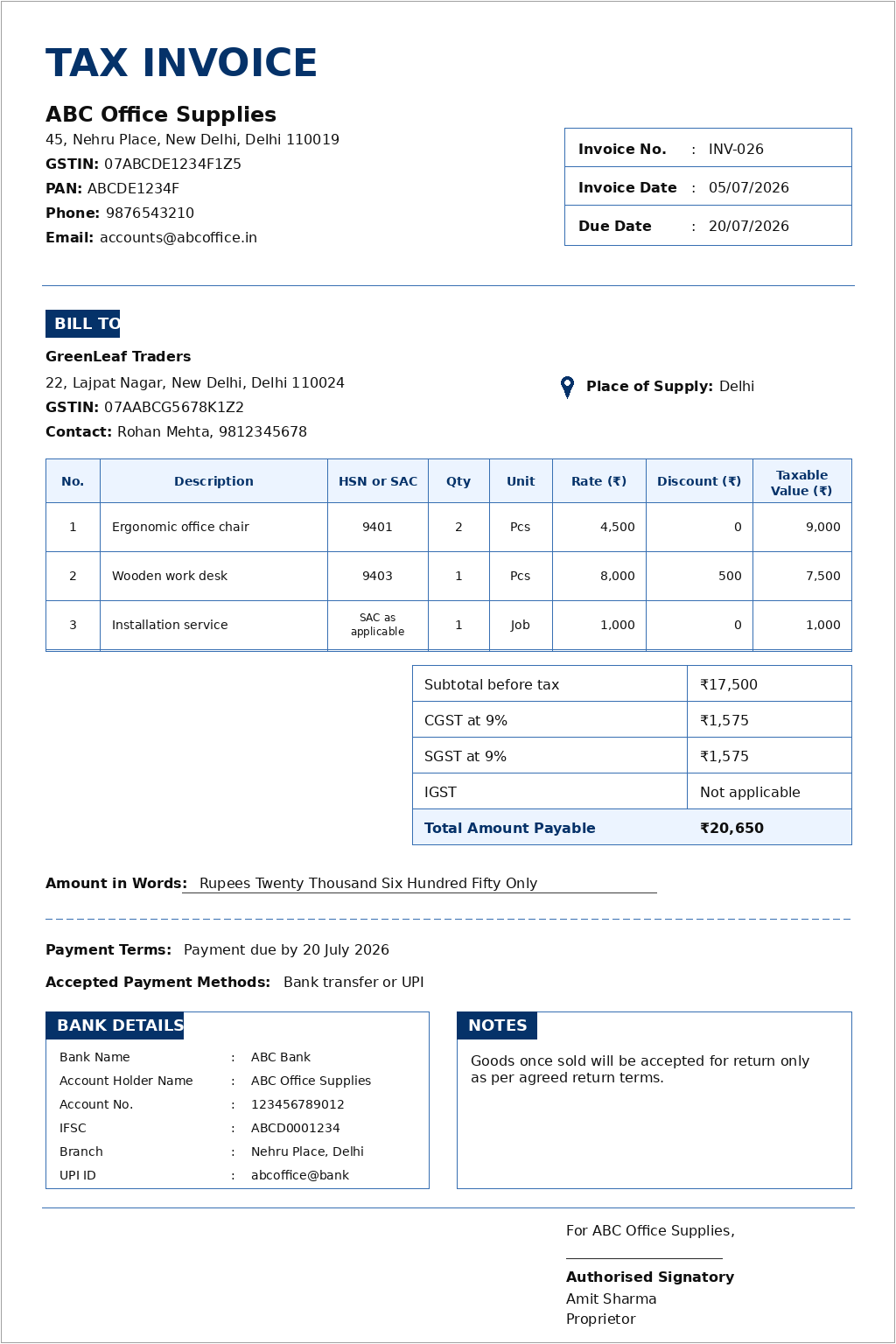
Here is an example of a filled-in invoice to show how the format works in practice. This sample assumes that both the seller and the buyer are in Delhi, so CGST and SGST apply. The GST rate used here is only for example. Use the correct HSN or SAC code and GST rate for your actual product or service.
Billing Format for Different Business Types
The basic billing format stays the same for most businesses. However, a few invoice details may change depending on what you sell.
| Business Type | What to Include in the Invoice | Example |
|---|---|---|
| Product-based businesses | Product name, HSN code where applicable, quantity, unit of measurement, and details like brand, size, colour, grade, or model. Add dispatch details if goods are sent separately. | Blue cotton shirts, size M, 50 pieces |
| Service-based businesses | Service name, SAC code where applicable, billing period, project name or work scope, and service quantity such as hours, days, visits, or milestones. | Website maintenance service for July 2026 |
| Mixed supply: goods and services | List goods and services as separate line items. Each line should have its own description, HSN or SAC code where applicable, tax rate, and amount. | Wooden table: ₹8,000; Installation charges: ₹1,000 |
Business Type
What to Include in the Invoice
Example
Business Type
What to Include in the Invoice
Example
Business Type
What to Include in the Invoice
Example
A clear billing format helps the buyer match the invoice with the order, service period, delivery, or work approval. This reduces confusion and makes payment processing easier.
Conclusion
A complete invoice gives the buyer the details needed to approve payment and gives you a clear record for accounting, GST filing, and follow-up.
Use the invoice format above as your starting point. Add all important details, keep GST fields correct where applicable, and mention a clear payment due date. A simple, well-made invoice can save time for both you and your buyer.