Cash Book, Bank Book, and Petty Cash Book: Meaning and Simple Formats
New business owners may record cash sales, UPI receipts, supplier payments, and small expenses in the same place. This makes it difficult to answer basic questions at the end of the day, such as: How much cash should be in the drawer? How much is available in the bank? Where were smaller amounts spent?
This guide shows how to maintain each record, handle transfers correctly and avoid counting the same amount twice.
Quick summary
- A cash book records money received and paid in physical cash.
- A bank book records transactions through the business bank account.
- A petty cash book tracks smaller expenses paid from a separate cash float.
- Opening balances are carried forward and are not counted as receipts for the current period.
- Transfers between cash, bank, and petty cash change where money is kept. They do not create income or an expense.
What Is a Cash Book?
A cash book records physical cash received and paid by the business. Its running balance shows how much cash should be available in the main drawer or cash box. A simple cash book may include:
- Cash sales.
- Cash collected from customers.
- Cash paid to suppliers.
- Cash purchases and expenses.
- Cash transferred to the bank or petty cash box.
- Cash withdrawn from the bank for business use.
UPI receipts, cheque payments, and online bank transfers are not physical cash. In the simple system used in this guide, they are entered in the bank book.
Simple Cash Book Format
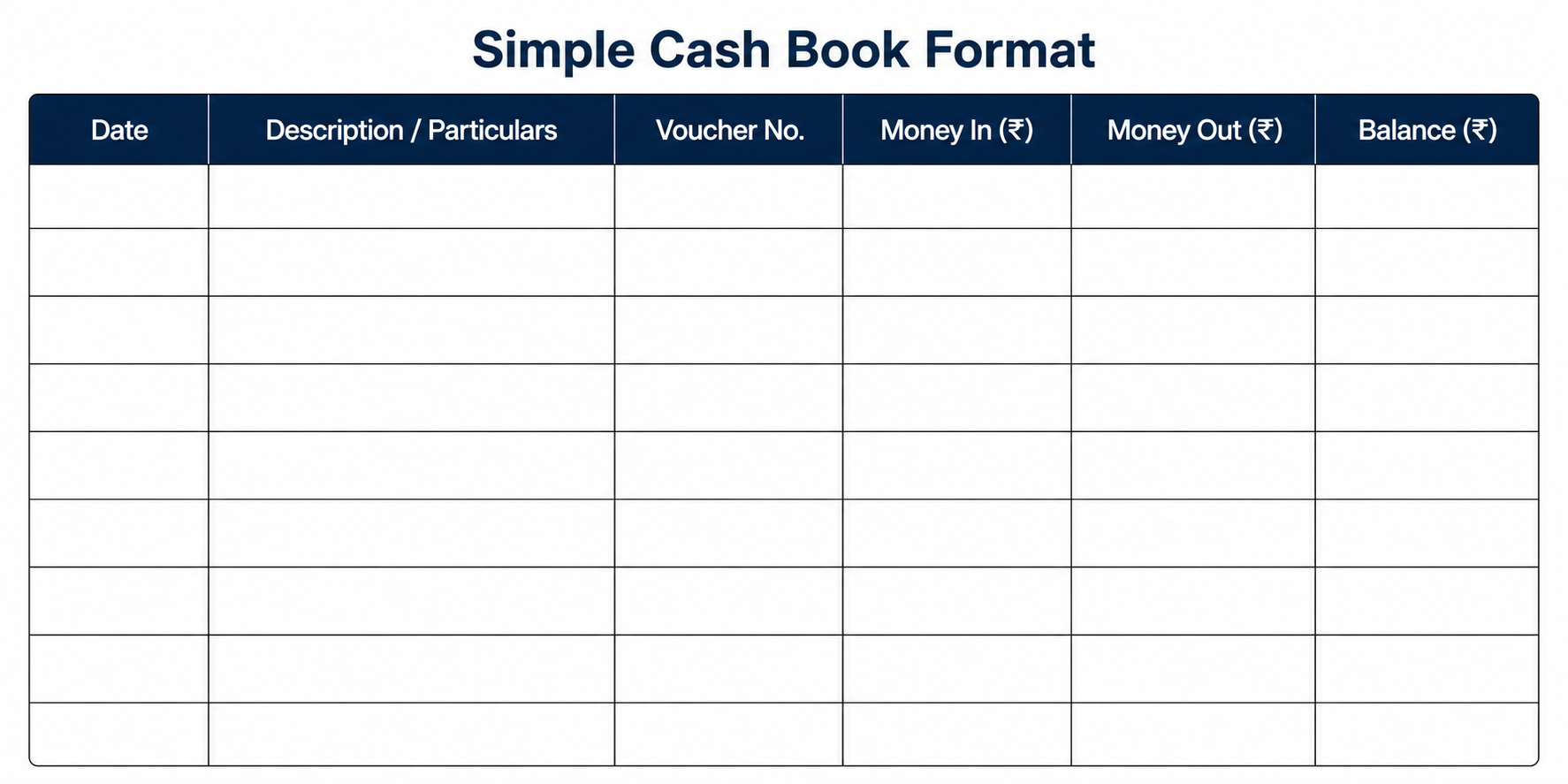
What each column means:
- Date: The date on which the transaction took place.
- Description / Particulars: Who paid the business, whom the business paid or why the money moved.
- Voucher No.: The receipt, payment or transfer reference number.
- Money In: Physical cash received.
- Money Out: Physical cash paid or transferred out.
- Balance: Previous balance plus money in, minus money out.
Filled Cash Book Example
Opening balance on 1 July: 5,000
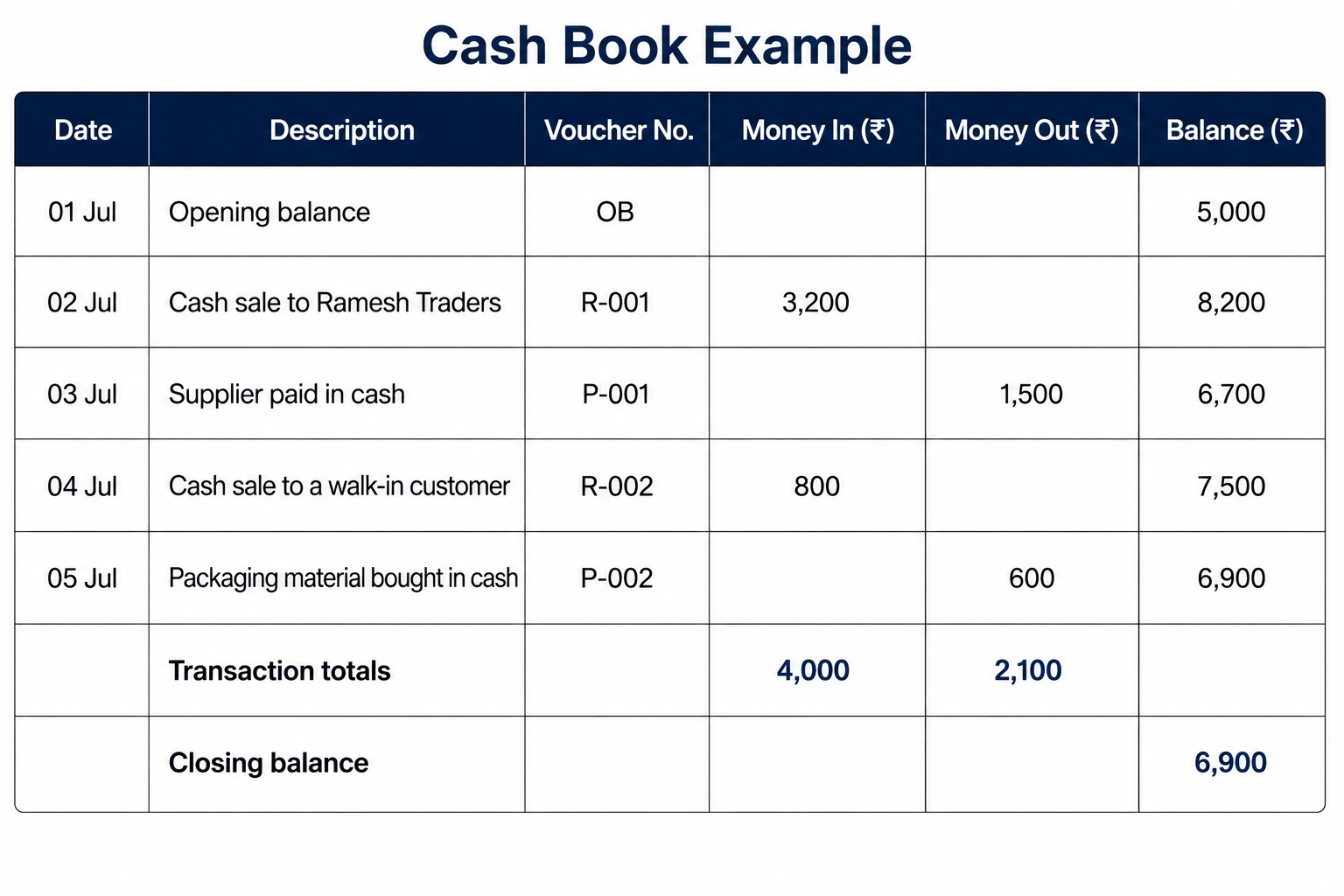
At the end of 5 July, the physical cash available should be ₹6,900. The ₹5,000 opening balance is shown only in the balance column. It is money carried forward from the previous period, so it is not included in the ₹4,000 received during the current period.
What Is a Bank Book?
A bank book is a record of transactions that pass through a business bank account. It adds useful details that may not be clear from the short descriptions shown in a bank statement. A bank book may include:
- UPI receipts settled into the bank account.
- NEFT, RTGS, and IMPS transfers.
- Cheques issued or deposited.
- Online bill and tax payments.
- Bank interest and charges.
- Cash deposited into or withdrawn from the bank.
- Refunds paid or received through the bank.
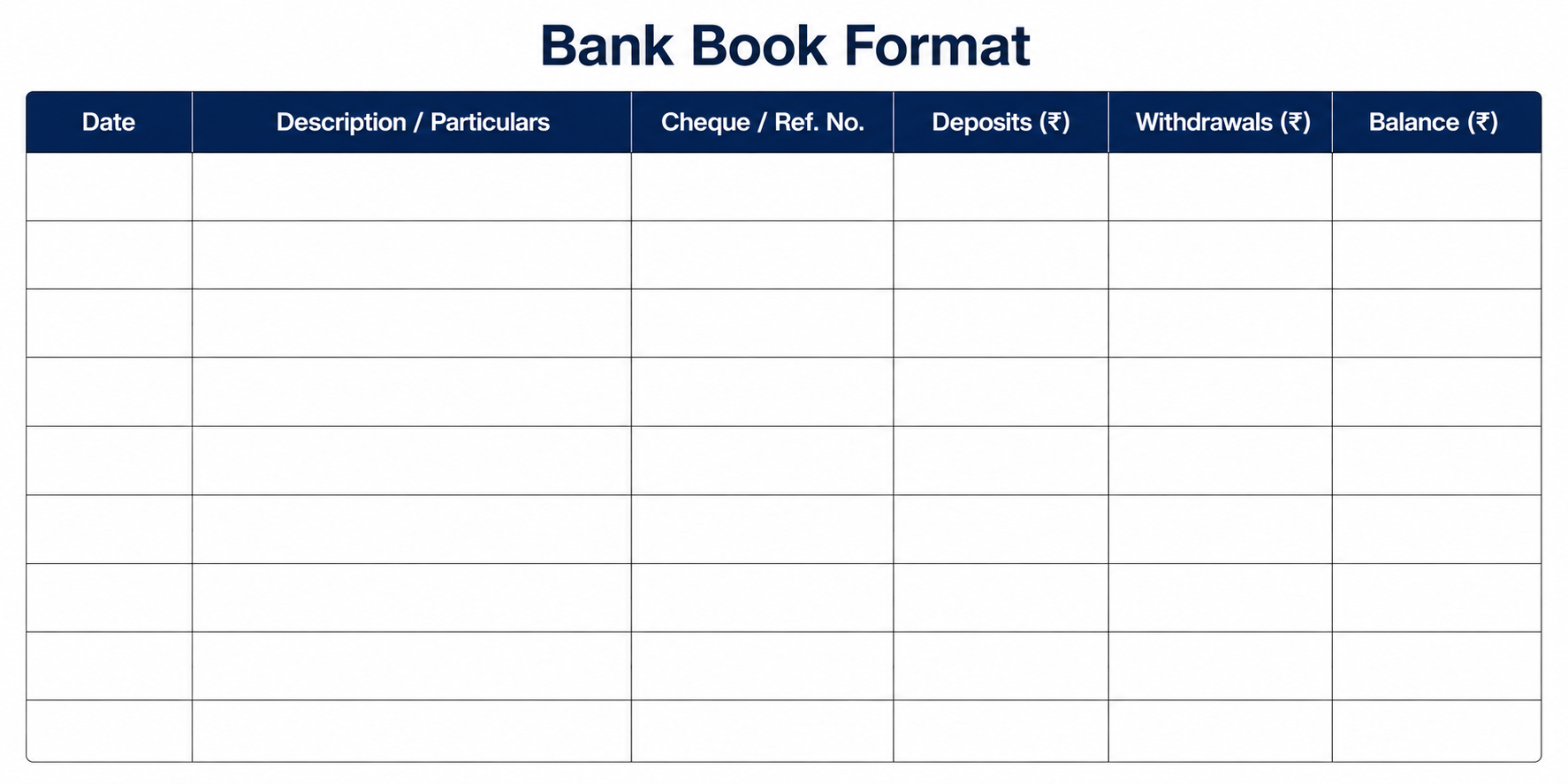
Simple Bank Book Format
Filled Bank Book Example
Opening balance on 1 July: 25,000
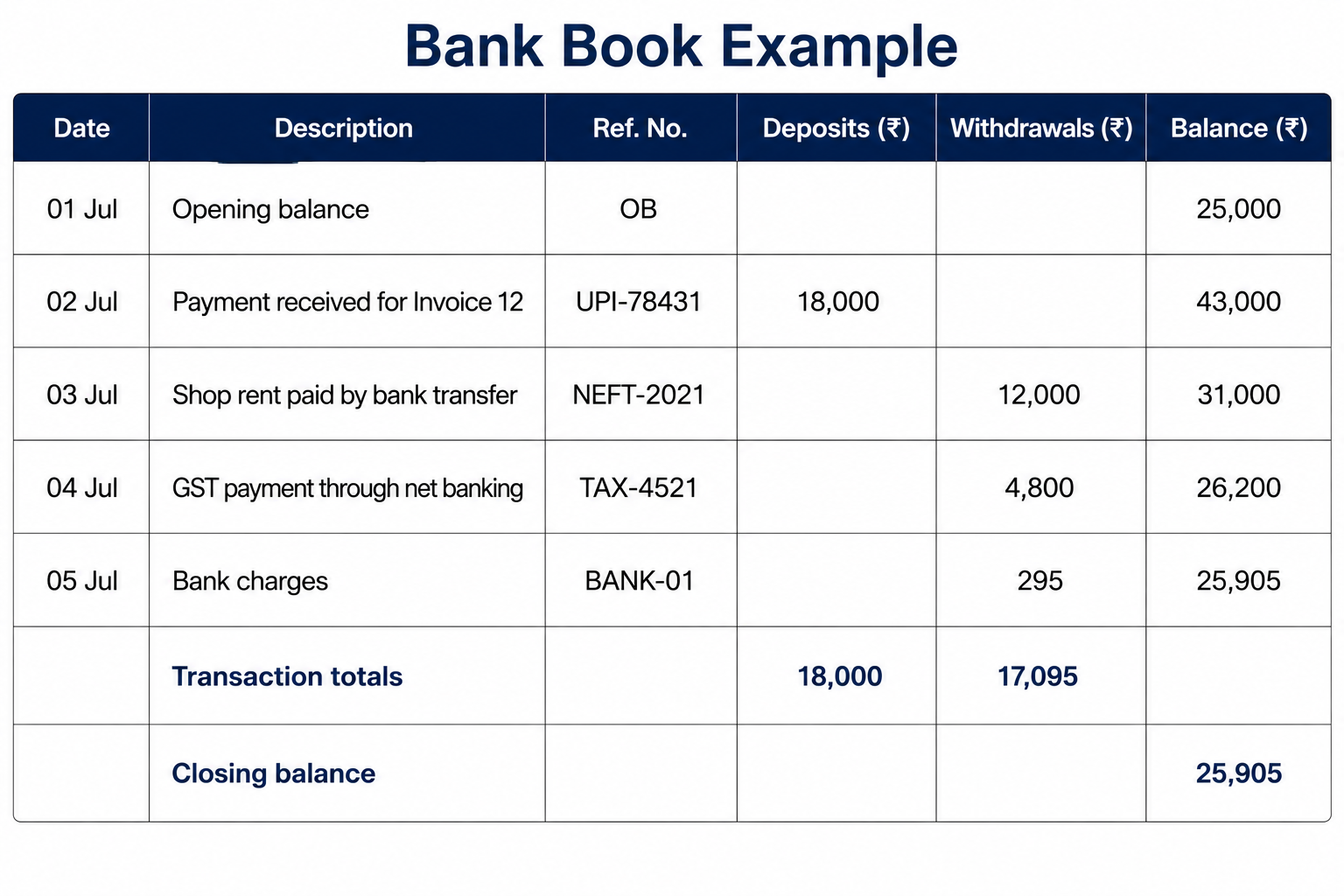
The closing bank book balance is ₹25,905. Compare the bank book with the bank statement at least at month-end, or more often when the business has many bank transactions. A difference may arise because a cheque has not cleared, a bank charge has not been entered, or a transaction has been missed.
What Is a Petty Cash Book?
A petty cash book records smaller expenses paid from a separate cash float. These expenses may include:
- Local travel.
- Courier charges.
- Office refreshments.
- Parking charges.
- Minor stationery purchases.
- Small office supplies.
There is no universal petty cash limit. The business should set a reasonable internal limit based on its normal spending and communicate it to the person responsible.
How the Imprest System Works
Under the imprest system, a fixed amount is kept as petty cash. Suppose a business sets the petty cash float at ₹2,000:
- ₹2,000 is placed in the petty cash box.
- Each expense is entered in the petty cash book.
- Bills or petty cash vouchers are kept as supporting proof.
- The remaining cash is counted at the end of the period.
- The approved amount spent is added back to restore the float to ₹2,000.
The following check should match:
Cash remaining + supported expenses = fixed petty cash amount
If ₹655 is spent from a ₹2,000 float, the remaining cash should be:
₹2,000 - ₹655 = ₹1,345
The business can then add ₹655 to bring the petty cash float back to ₹2,000.
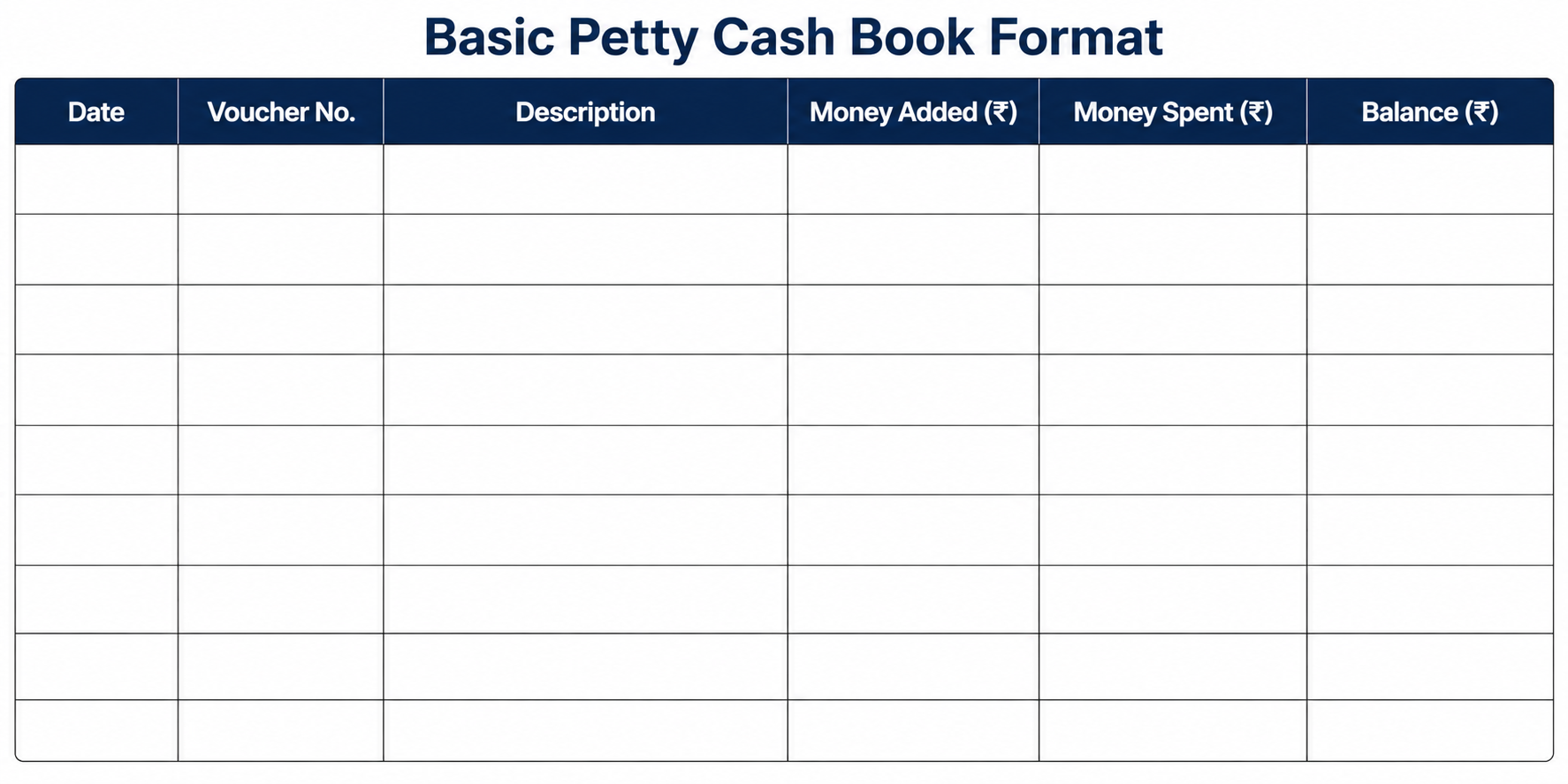
Basic Petty Cash Book Format
Analytical Petty Cash Book Format
An analytical petty cash book separates expenses by category. This makes it easier to see how much was spent on travel, stationery, refreshments, and other items.
Example: Opening petty cash balance: ₹2,000
Period: 1 to 7 July
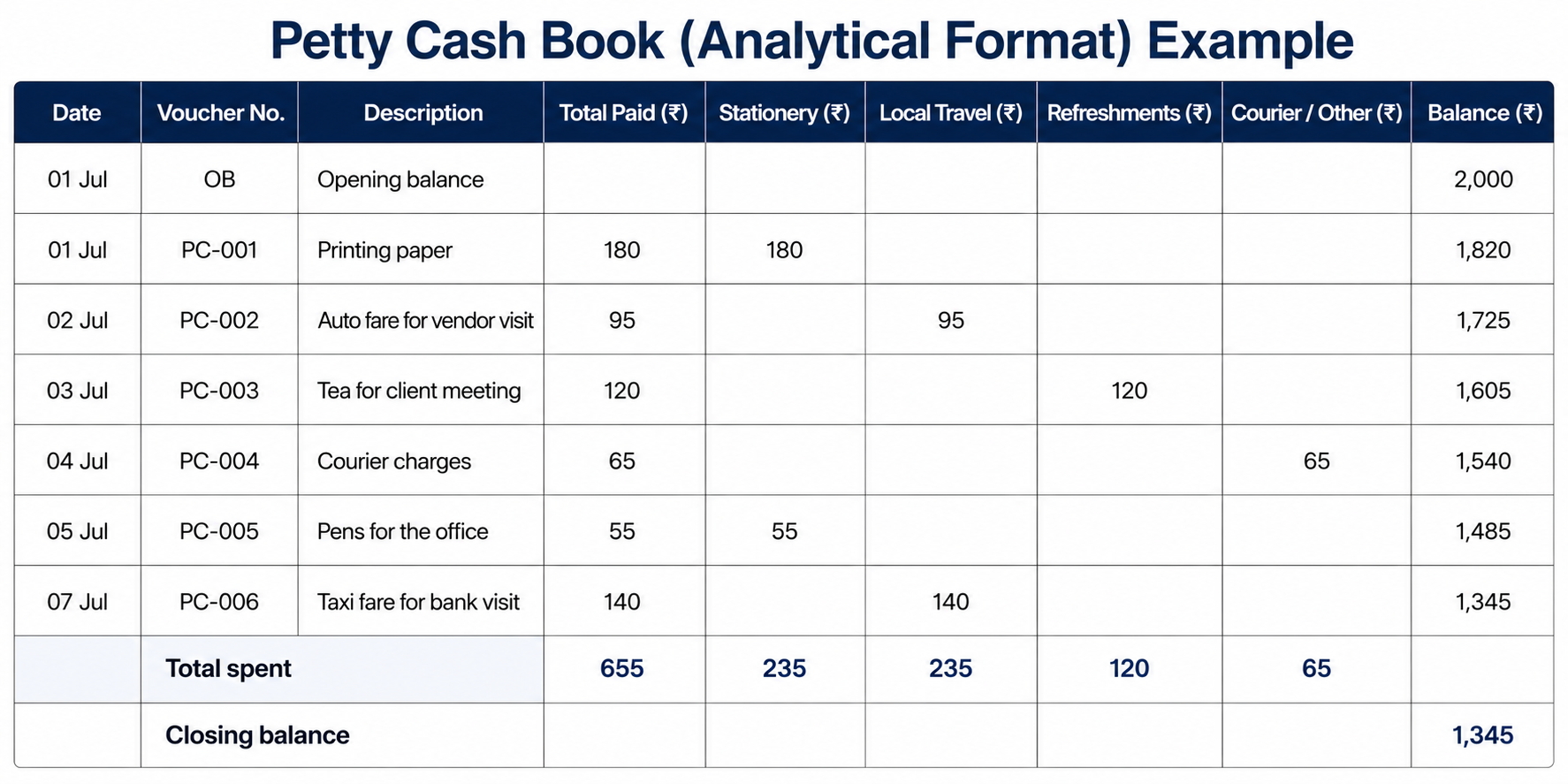
The category totals add up to ₹655. The remaining cash of ₹1,345 plus the supported expenses of ₹655 equals the original ₹2,000 petty cash float.
How to Record Transfers Between the Books
Money may move between the cash drawer, bank account, and petty cash box. These movements must be entered in both relevant books, but they must not be treated as new income or an expense.
Cash Deposited into the Bank
Suppose ₹2,000 is deposited from the main cash drawer into the bank account.
| Record | Entry |
|---|---|
| Cash book | Money Out: ₹2,000 |
| Bank book | Deposit: ₹2,000 |
Record
Entry
Record
Entry
Use the same reference number in both books so the transfer can be traced easily.
Cash Withdrawn from the Bank
Suppose ₹3,000 is withdrawn from the bank for use in the main cash drawer.
| Record | Entry |
|---|---|
| Bank book | Withdrawal: ₹3,000 |
| Cash book | Money In: ₹3,000 |
Record
Entry
Record
Entry
The business has not earned ₹3,000. It has only changed where the money is kept.
Money Transferred to Petty Cash
Suppose ₹1,000 is transferred from the main cash drawer to the petty cash box.
| Record | Entry |
|---|---|
| Cash book | Money Out: ₹1,000 |
| Petty cash book | Money Added: ₹1,000 |
Record
Entry
Record
Entry
Individual petty cash expenses are then recorded only in the petty cash book. Entering the same expenses again in the main cash book would double-count them.
Cash Book vs Bank Book vs Petty Cash Book
| Point | Cash Book | Bank Book | Petty Cash Book |
|---|---|---|---|
| Main purpose | Tracks physical cash received and paid | Tracks transactions through the business bank account | Tracks smaller expenses paid from a separate cash float |
| Typical entries | Cash sales, collections, and supplier payments | UPI receipts, transfers, tax payments, and bank charges | Local travel, stationery, refreshments, and courier expenses |
| Checked against | Physical cash in the main drawer or cash box | Bank statement | Cash remaining plus supported petty cash expenses |
| When to update | After each transaction or at the end of the day | After each transaction or during regular bank checks | At the time of each expense |
| Supporting proof | Receipt or payment voucher | Bank reference, statement or payment confirmation | Bill, receipt or signed petty cash voucher |
Point
Cash Book
Bank Book
Petty Cash Book
Point
Cash Book
Bank Book
Petty Cash Book
Point
Cash Book
Bank Book
Petty Cash Book
Point
Cash Book
Bank Book
Petty Cash Book
Point
Cash Book
Bank Book
Petty Cash Book
A Simple Daily Record-Keeping Routine
- Collect transaction proof. Keep bills, receipts, bank references, and signed vouchers.
- Choose the correct book. Enter physical cash in the cash book, bank transactions in the bank book, and smaller cash expenses in the petty cash book.
- Use clear reference numbers. Give each receipt, payment, and transfer a traceable number.
- Update the balance. Calculate the running balance after each entry.
- Count physical cash. Compare the cash book and petty cash balances with the money actually available.
- Review bank entries. Match the bank book with the bank statement and investigate any difference.
- Keep the records safely. Restrict editing access and keep regular backups if the records are maintained digitally.
For businesses moving beyond notebooks and spreadsheets, mazu lets you create invoices and record cash, UPI and bank payments in one place, making daily tracking easier.
Common Mistakes to Avoid
Recording UPI Receipts as Physical Cash
UPI payments normally settle into a bank account. Record them in the bank book unless the amount is held in a separate wallet or settlement account.
Entering Petty Cash Expenses Twice
When a separate petty cash book is maintained, enter each small expense there. Do not record the same expense again as an individual payment in the main cash book.
Using Vague Descriptions
Entries such as “expense”, “payment” or “received” do not explain the transaction. Write a useful description, such as “cash received against Invoice 24” or “courier charges for customer delivery”.
Ignoring Bank-Generated Entries
Bank charges, interest credits, and returned cheque charges may appear only in the bank statement. Enter them in the bank book before completing the reconciliation.
Reusing the Same Voucher Number
Each voucher or receipt number should identify one transaction. Reusing numbers makes documents difficult to trace and may hide duplicate entries.
Changing the Balance to Make It Match
Do not change an amount merely to make the recorded and physical balances agree. First check for missed entries, duplicate transactions, incorrect figures, and unrecorded transfers.
Tax and Record-Keeping Requirements in India
The formats in this guide are practical bookkeeping formats. They do not replace invoices, ledgers, stock records, tax registers, or other records required for a particular business.
Under GST, a registered person must maintain true and correct accounts of matters such as inward and outward supplies, stock, input tax credit, output tax payable, and tax paid. Additional records may be required under the CGST Rules, depending on the business.
GST records generally need to be retained for 72 months from the due date for furnishing the annual return for the relevant year. Records connected with an appeal, investigation, or other proceeding may need to be kept for longer.
A separate cash book in the exact format shown here is not compulsory for every business. Under Rule 46 of the Income-tax Rules, 2026, specified professionals may be required to maintain prescribed books when the applicable conditions are met. The rule defines a cash book as a day-to-day record of cash receipts and payments that shows the cash balance at the end of each day or a period not exceeding one month.
Businesses should confirm their exact record-keeping requirements with an accountant or tax professional.
Conclusion
A cash book, bank book, and petty cash book help a new business owner see where money is held and how it is being used.
The main cash book tracks physical cash, the bank book tracks the business bank account, and the petty cash book controls smaller expenses. Keeping these records separate also reduces the risk of counting the same transaction twice.
The formats can remain simple. What matters is entering transactions promptly, using clear references, keeping supporting proof, and checking the balances regularly.