Accounts Receivable Meaning for Small Businesses
Many small businesses deliver goods or complete services before receiving payment. The sale is done, but the money is still pending. During this period, the unpaid amount is recorded as accounts receivable.
In the beginning, it may feel easy to remember who has paid and who has not. But once you have more customers, more invoices, and different payment dates, it becomes difficult to track everything from memory.
Quick summary
- Accounts receivable is the money customers owe your business for goods or services already delivered but not yet paid for.
- It is shown as a current asset, which means money your business expects to receive soon.
- Every unpaid customer invoice is part of your accounts receivable until the payment is collected.
- High sales do not always mean healthy cash flow if many customers are paying late.
- A clear receivables record helps you know who owes money, how much they owe, and when payment is due.
- For small businesses, tracking customer outstanding regularly can reduce cash flow stress and late-payment surprises.
That is where accounts receivable becomes important. It helps you track unpaid customer invoices, see how long payments have been pending, and follow up before cash flow becomes tight.
What Is Accounts Receivable?
Accounts receivable is the total amount customers owe your business for goods or services they have already received but have not yet paid for. In simple words, it is the money your business has yet to collect.
When you sell on credit, you deliver first and allow the customer to pay after a few days. Until the customer pays, that unpaid invoice is part of your accounts receivable. Common examples of accounts receivable in a small business include:
- You supply ₹30,000 worth of goods to a retailer on 30-day credit.
- You complete a design project for a client and send an invoice due in 15 days.
- You provide monthly maintenance services and bill customers at the end of the month.
- You supply catering for an event, and the customer pays two weeks later.
Accounts Receivable vs Accounts Payable: What Is the Difference?
Accounts receivable and accounts payable sound similar, but they mean opposite things. A useful way to remember this: Receivable means money coming to you. Payable means money going from you.
| Accounts Receivable | Accounts Payable | |
|---|---|---|
| What it means | Money customers owe your business | Money your business owes suppliers |
| Who has to pay | Your customers have to pay you | You have to pay your suppliers |
| Type of balance | Asset | Liability |
| Simple meaning | Money to receive | Money to pay |
Accounts Receivable
Accounts Payable
Accounts Receivable
Accounts Payable
Accounts Receivable
Accounts Payable
Accounts Receivable
Accounts Payable
For example, if Ramesh Traders owes you ₹20,000, that is accounts receivable. If you owe your supplier ₹15,000, that is accounts payable.
Where Does Accounts Receivable Appear in Your Financial Records?
Accounts receivable appears in different reports because one unpaid invoice can affect sales, cash flow, and your balance sheet differently.
On the balance sheet
A balance sheet is a report that shows what your business owns and what it owes. Accounts receivable appears under current assets. A current asset means money or value your business expects to receive soon, usually within 12 months.
In many accounting records, accounts receivable may also be called trade debtors or sundry debtors. These are accounting terms for customers who owe your business money.
In the profit and loss statement
A profit and loss statement, often called P&L, shows your business income and expenses. In most business accounts, especially when using accrual accounting, the sale is recorded when the invoice is raised, even if the customer has not paid yet. Accrual is one of the fundamental accounting assumptions recognised under Accounting Standard 1, which means income and expenses are recorded in the period they relate to, not only when cash is received or paid.
So if you raise an invoice for ₹50,000 today, your sales may show ₹50,000 even though the cash has not reached your bank account.
In the cash flow statement
Cash flow means actual money coming into and going out of your business. The customer payment appears in your cash flow only when the money is actually received. This is why your sales can look good, but your bank balance may still feel low.
How Accounts Receivable Works in Practice
For instance, on 5 June, you deliver goods worth ₹25,000 to Priya Electronics and raise Invoice #1045, due in 30 days. This means:
- Your recorded sales increase by ₹25,000.
- Priya Electronics now owes you ₹25,000.
- Your accounts receivable increases by ₹25,000.
On 5 July, Priya Electronics pays ₹25,000 by bank transfer. This means:
- Your bank balance increases by ₹25,000.
- Your accounts receivable decreases by ₹25,000.
- The invoice is now settled.
Between 5 June and 5 July, ₹25,000 sits in your accounts receivable. Your business has made the sale, but the money has not yet arrived.
What a Receivables Record Looks Like
A receivables record helps you track unpaid customer invoices in one place. It usually includes the customer name, invoice number, invoice date, amount owed, due date, payment status, and days overdue, if any. Here is a simple example:
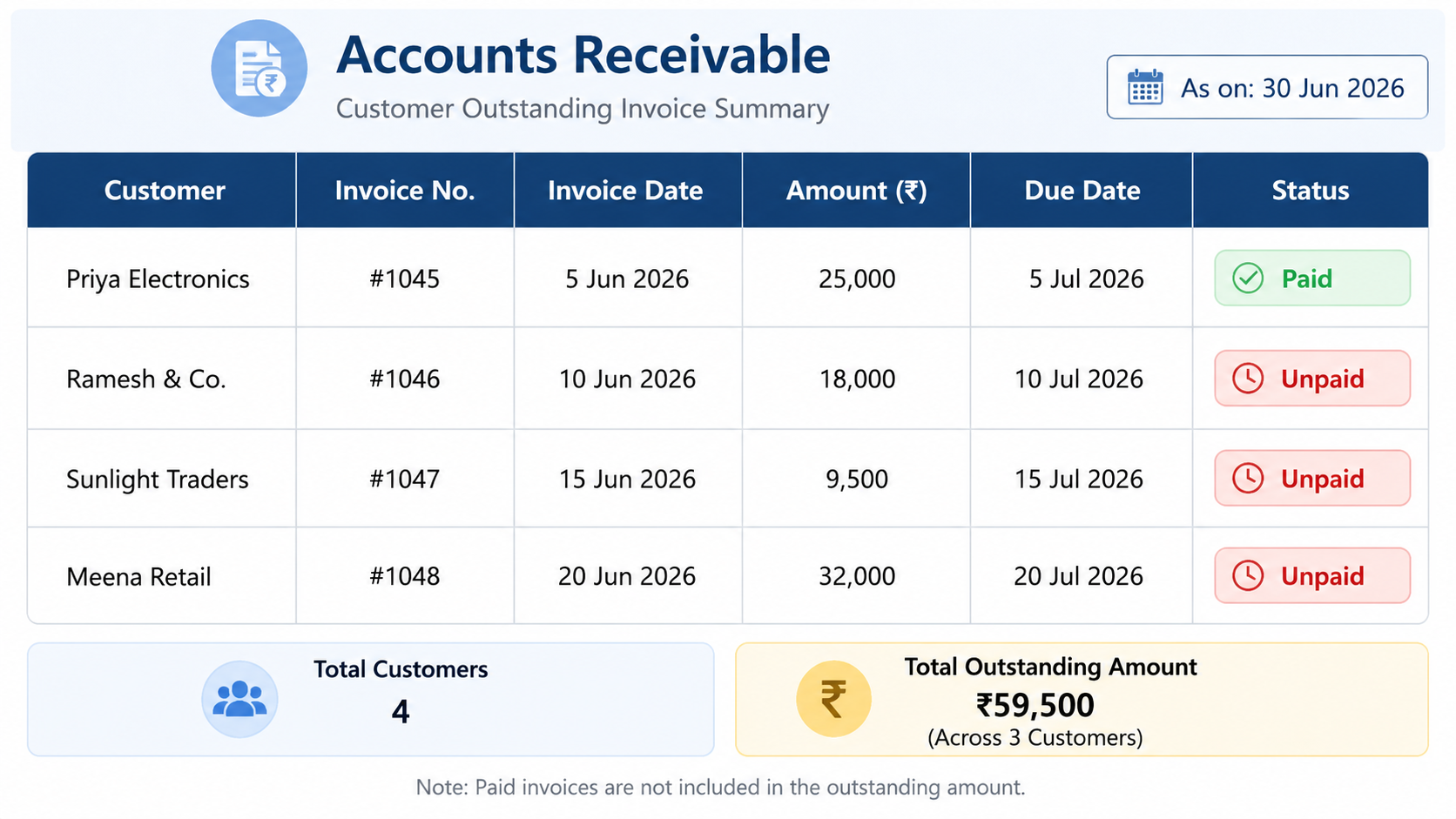
At a glance, this tells you that ₹59,500 is still unpaid across three customers. It also shows which payments are due soon.
If you maintain this manually, you need to update it every time you raise an invoice or receive payment. If you use accounting or invoicing software, this record can update automatically when invoices and payments are entered correctly.
Why Managing Receivables Matters
Managing receivables is not just an accounting task. It helps you know whether you have enough cash coming in to pay suppliers, buy stock, cover rent, and take new orders on time.
You know who owes you money
Without a receivables record, unpaid invoices can easily be forgotten. A customer may delay payment simply because no one followed up. Keeping every pending amount visible reduces that risk.
You can follow up on time
Following up close to the due date is usually easier than chasing payment after two or three months. When you know the due date, you can send a reminder before the payment becomes a serious issue.
You can plan supplier payments
If you know which customer payments are expected this week or next week, you can plan your own payments better. This helps you decide whether you can pay suppliers, buy new stock, or take a new order confidently.
You can spot slow-paying customers early
Some customers always pay late. If you track receivables regularly, you can identify these patterns early. You may then reduce their credit limit, ask for advance payment, or follow up more strictly.
Your reports become more accurate
If customer outstanding is not recorded properly, your sales, debtors balance, and cash position may not reflect the real picture. Clean receivables records help your accountant prepare more reliable accounts.
Ageing of Receivables: How Long Invoices Have Been Pending
An ageing report groups unpaid invoices by how long they have been pending. This helps you understand which invoices are still fresh and which ones need urgent follow-up.
| Age Bracket | Amount Outstanding (₹) |
|---|---|
| 0-30 days | 45,000 |
| 31-60 days | 22,000 |
| 61-90 days | 8,500 |
| Over 90 days | 4,000 |
| Total | 79,500 |
Age Bracket
Amount Outstanding (₹)
Age Bracket
Amount Outstanding (₹)
Age Bracket
Amount Outstanding (₹)
Age Bracket
Amount Outstanding (₹)
Age Bracket
Amount Outstanding (₹)
This report tells you more than a single total. The ₹45,000 in the 0-30-day bucket may still be within normal payment time. The ₹22,000 in the 31-60 day bucket needs follow-up. The ₹4,000 pending for over 90 days needs urgent attention because it may become difficult to collect.
For a small business, checking receivables ageing once a week or at least once a month is a useful habit.
Practical Ways to Improve Collections
Send invoices immediately
Do not wait until the end of the week or month. Raise the invoice as soon as the goods are delivered or the service is completed. A delayed invoice usually means delayed payment.
Mention payment terms clearly
Every invoice should clearly say when payment is due. For example, “Payment due within 15 days of invoice date.” Also include your bank details, UPI ID, or payment link so the customer does not have to ask how to pay.
Follow up before or on the due date
A polite reminder before the due date is not rude. It is professional. Many payments are delayed only because no one reminded the customer.
Keep a fixed overdue process
Decide in advance what action you will take when an invoice becomes overdue. For example, you can send a polite reminder after 7 days, call the customer after 15 days, and send a formal message or review future credit after 30 days.
Make payment easy
The fewer steps a customer has to take, the faster they are likely to pay. Offer common options such as UPI, bank transfer, and payment links where suitable.
Set a simple credit rule
Before supplying more goods on credit, check whether the customer already has overdue invoices. For example, you may decide not to give new credit if older invoices are overdue beyond 30 days.
Use a clear invoicing and payment record
Collections become easier when every invoice, due date, and payment status is visible in one place. Tools like mazu can help small business owners keep invoices organised and track who owes what without depending only on memory or scattered notes.
Accounts Receivable and GST
For GST-registered businesses in India, the GST amount on a sales invoice is also part of the receivable from the customer. The customer owes the full invoice value, including GST.
However, GST liability may arise even if the customer has not paid yet, because GST is linked to time of supply rules. For goods, CBIC explains that the time of supply is generally the earlier of the invoice date or the payment receipt date, with separate rules for different cases and services.
For regular taxpayers, this is usually reported and paid through the GST return and payment cycle applicable to them, such as GSTR-3B, depending on their filing frequency and registration type. The GST Portal states that taxpayers declare and discharge GST liabilities for a particular tax period in Form GSTR-3B, and quarterly filers follow separate timelines from monthly filers.
Output GST means GST charged on your sales and payable to the government, where applicable. Since GST treatment can depend on registration type, return frequency, and transaction details, unpaid GST invoices should be reviewed with your accountant or CA.
How Your Accountant Uses Receivables Records
Your accountant uses your receivables records to check whether all sales invoices have been recorded. They also use these records to match customer payments with the correct invoices and calculate the customer outstanding figure shown as debtors on the balance sheet.
These records can also help identify invoices that may not be collected and check whether GST has been charged and recorded correctly, where applicable.
At year-end, unpaid customer invoices form part of your closing accounts receivable balance. If any amount is genuinely not recoverable, your accountant may advise writing it off as a bad debt. A bad debt means money that the business is unlikely to collect from the customer.
Conclusion
Accounts receivable is the money your customers owe you. For a small business, it is one of the most important numbers to track because it shows how much money is still pending after sales have been made.
Good receivables management helps you know who owes money, when payment is due, and which customers need follow-up. It also helps you plan cash flow better and avoid unnecessary stress when supplier payments, rent, salaries, or GST dues come up.
If you are just starting, build one simple habit: raise invoices on time, record every payment properly, and review customer outstanding regularly. This routine helps you collect faster, avoid forgotten dues, and make better payment decisions.