Accounts Payable Meaning for Small Businesses
When you start a business, it is easy to focus on sales, stock, and daily expenses. But there is another number you need to watch closely: how much your business still has to pay to suppliers.
If supplier bills are not tracked properly, you may think your cash position is stronger than it actually is. Accounts payable helps you see these unpaid bills clearly, so you know what is due, who needs to be paid, and when the payment should go out.
Quick summary
- Accounts payable is the total amount your business owes to suppliers and vendors for goods or services already received but not yet paid for.
- AP is a short form for accounts payable. In accounting, AP simply means supplier bills that your business has not yet paid.
- Accounts payable is treated as a current liability, meaning money your business owes in the short term.
- A payables record should show the supplier name, invoice amount, due date, and payment status.
- Tracking payables helps you plan supplier payments, avoid missed due dates, and protect supplier relationships.
- Managing accounts payable effectively is an important habit for a business just starting out.
This guide explains what accounts payable is, why it matters, and how to manage supplier payments when your business is still new.
What Is Accounts Payable?
Accounts payable is the total amount your business owes to suppliers, vendors, and service providers for goods or services you have already received but not yet paid for. AP is a common short form for accounts payable. In accounting, AP meaning is simple: supplier bills that are still unpaid.
The word “payable” means money that needs to be paid. When a supplier gives you goods on credit, meaning you take the goods now and pay later, the amount you owe becomes part of your accounts payable until you settle it. Some common examples include:
- You purchase packaging materials from a supplier on 30-day credit.
- A freelance designer completes a branding project and sends you an invoice due in 15 days.
- Your internet service provider bills you monthly, and you pay at the end of each month.
- A wholesaler supplies you with stock on credit, with payment due in 45 days.
These examples show how payables can come from stock purchases, services, utilities, and supplier credit.
Accounts Payable vs Accounts Receivable: What Is the Difference?
These two terms are often mentioned together and are easy to confuse when you are starting out. A simple way to remember the difference is: payable = you pay, receivable = you receive.
| Accounts Payable | Accounts Receivable | |
|---|---|---|
| What it is | Money your business owes to others | Money others owe to your business |
| Who owes whom | You owe your suppliers | Your customers owe you |
| Where it appears | Current liability on the balance sheet | Current asset on the balance sheet |
| Simple way to remember | Bills you need to pay | Invoices you need to collect |
Accounts Payable
Accounts Receivable
Accounts Payable
Accounts Receivable
Accounts Payable
Accounts Receivable
Accounts Payable
Accounts Receivable
How Accounts Payable Works in Practice
Let us walk through a simple example.
2 June: You receive goods worth ₹40,000 from Ramesh Traders on 30-day credit.
- Your stock increases by ₹40,000.
- Your accounts payable increases by ₹40,000 because you owe Ramesh Traders.
2 July: You pay Ramesh Traders ₹40,000 by bank transfer.
- Your bank balance decreases by ₹40,000.
- Your accounts payable decreases by ₹40,000 because the debt is settled.
Between 2 June and 2 July, ₹40,000 sits in your accounts payable. It is a real obligation. You owe that money, even though it has not left your bank account yet.
Where Does Accounts Payable Appear in Your Financial Records?
On the Balance Sheet
Accounts payable is usually shown under current liabilities. A current liability means money your business needs to pay in the short term, usually within 12 months.
In company financial statements, similar supplier dues are commonly shown as trade payables. A higher accounts payable balance means your business has more unpaid supplier dues at that point.
In the Profit and Loss Statement
When you receive a supplier bill, the purchase or expense is recorded in your books even if payment is still pending. For services, it is usually recorded as an expense. For stock or goods, it may be recorded as purchases or inventory first, and then reflected correctly in profit calculation based on stock sold and closing stock.
So if you receive ₹50,000 worth of stock on credit, your books record the purchase and the amount payable. Your accounts payable shows that ₹50,000 is still outstanding.
In the Cash Flow Statement
If your business prepares a cash flow statement, the actual payment to the supplier appears there only when money leaves your bank or cash account. This is why your profit and cash position can look different. The purchase may be recorded before the payment is made.
Why Keeping Track of Payables Matters
You Always Know What You Owe
When you have multiple suppliers, it is easy to lose track of which bills are due when. Without a clear record, you risk missing a payment or paying the wrong amount. A proper payables record tells you exactly what is outstanding, whom you need to pay, and when each amount is due.
You Protect Supplier Relationships
Suppliers who extend credit are trusting your business to pay later. Paying them on time, or communicating early if there is a delay, helps build trust and maintain favourable credit terms. A supplier who is paid reliably is more likely to continue providing credit during busy seasons or in response to urgent stock requirements.
You Avoid Late Payment Penalties and Legal Issues
Tracking payables helps you plan supplier payments before they become overdue. This can help you avoid late fees, blocked credit, and strained supplier relationships.
If your supplier is a registered micro or small enterprise, delayed payment may also have legal and financial consequences. Under MSME payment rules, the agreed payment period cannot exceed 45 days from acceptance or deemed acceptance of goods or services. If there is no written agreement, the timeline is generally linked to the appointed day under the MSMED Act, so check the correct due date with your accountant or CA.
You Get a Clearer Picture of Your Business’s Financial Health
Your accounts payable balance is part of your current liabilities. If it is growing faster than your sales or your cash position, it may signal that the business is stretching credit beyond what it can manage.
For example, your bank account may show ₹2 lakh today, but if ₹1.5 lakh of supplier bills are due next week, your real available cash is much lower. Tracking payables helps you avoid this kind of cash flow surprise.
How Accounts Payable Connects to Working Capital
Accounts payable is a key part of your working capital picture. Working capital is the money available to run your day-to-day business after accounting for short-term assets and short-term liabilities. Since accounts payable increases your short-term liabilities, it directly affects your working capital.
Payables can work like short-term credit because the supplier allows you to receive goods or services before making payment. This can help cash flow, but only if you pay within the agreed terms.
The right approach is simple: use the credit period your suppliers offer, but do not stretch beyond it. Delaying payment past the agreed terms damages trust and can result in stricter terms, penalties, or no credit at all in the future.
For businesses that want an easier way to track supplier and customer ledgers, mazu helps keep payables and receivables organised in one place, so you can check outstanding amounts without searching through separate records.
What a Payables Record Looks Like
Even a basic accounts payable register helps you stay organised. It typically tracks the supplier name, invoice number, and date, amount owed, due date for payment, and payment status, such as paid or unpaid. Here’s an example:
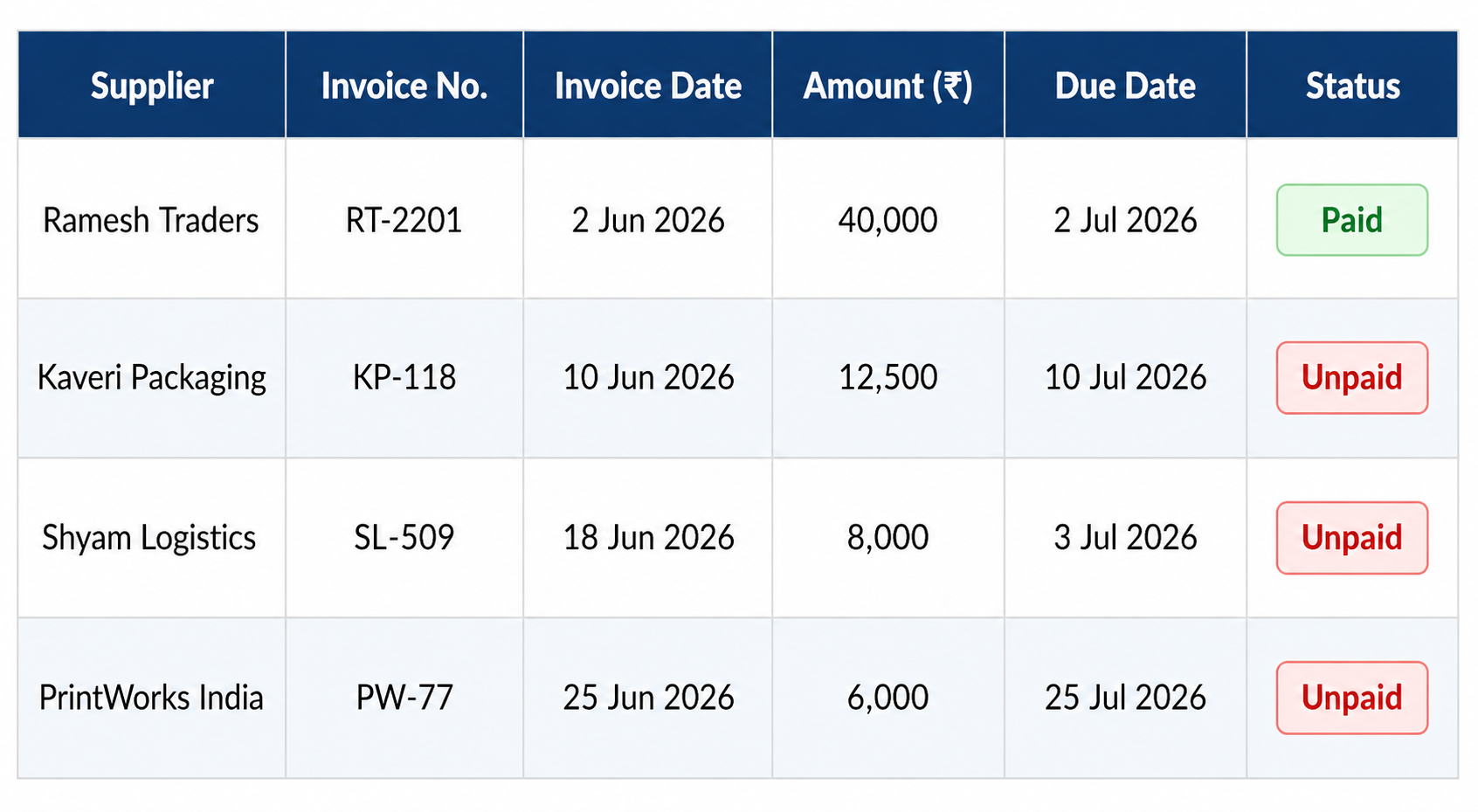
At a glance, this indicates that ₹26,500 remains outstanding across three suppliers, with Shyam Logistics due the soonest.
When you use accounting software, this record is maintained automatically as you enter supplier bills and log payments. Your supplier ledger updates in real time, so you do not have to manually calculate what you owe.
Accounts Payable and GST: What to Keep in Mind
In India, many supplier invoices include GST. If your business is GST-registered, the GST paid on eligible business purchases may be claimed as Input Tax Credit, subject to GST rules.
To claim ITC, you generally need a valid GST invoice or debit note, receipt of the goods or services, eligible business use, supplier details reflected as required under GST, and proper return filing. This means your payables record should capture:
- The base amount of each bill
- The GST amount on each bill
- Whether the supplier is GST-registered
- Whether the purchase is eligible for ITC under GST rules
- The payment due date for the supplier invoice
One GST payment rule is especially important. If payment to the supplier is not made within 180 days from the invoice date, the ITC already claimed may need to be reversed with interest. You can generally claim it again after making the payment, subject to GST rules.
If GST is not tracked properly on your payables, you may miss eligible ITC claims, claim ITC incorrectly, or make errors in your GST returns. Your accountant or CA can help confirm the correct treatment for your business.
Common Mistakes to Avoid With Accounts Payable
Not Recording Supplier Bills When They Arrive
Many business owners only record a purchase when they pay for it. But if you receive goods on credit and do not record the bill immediately, your books will not show the liability. This means your outstanding dues look lower than they actually are, and you may think you have more free cash than you really do.
Losing Track of Due Dates
Enter the due date at the same time as the supplier bill. If the due date is added later, it is easy to miss payment reminders, especially when different suppliers offer different credit periods.
Paying the Wrong Supplier or the Wrong Amount
When you have multiple suppliers with similar names, or multiple bills from the same supplier, it is easy to pay the wrong invoice or double-pay by mistake. Reconciling payments to specific invoices, rather than just making a transfer, keeps your records clean.
Mixing Personal and Business Payments
Paying a supplier bill from a personal account or paying a personal expense from the business account creates confusion in your payables record. It also makes year-end accounts harder to finalise. Keep supplier payments linked to the correct business account wherever possible.
Ignoring Small Outstanding Amounts
A ₹500 unpaid bill may seem insignificant, but if it goes unrecorded and unchecked, it can remain in your books for months and distort your payables balance. Clear small balances regularly and confirm with suppliers when accounts are fully settled.
Accounts Payable and Your Accountant
Your accountant or bookkeeper uses your payables records to check whether all supplier bills are recorded, payments are matched to the correct invoices, and your total creditors (trade payables) balance is accurate for the balance sheet. They also review whether GST Input Tax Credit is correctly captured and whether any supplier balances are overdue.
At year-end, unpaid supplier bills form part of your closing accounts payable balance. This appears as a current liability on your balance sheet. Any bills you owe but have not yet entered should be recorded before the accounts are finalised.
Conclusion
For a new business owner, the real value is not just knowing the definition. It is knowing how much you owe, who needs to be paid, and when each payment is due.
Recording every supplier bill when it arrives, tracking due dates, and paying on time helps keep your books accurate, your supplier relationships strong, and your working capital under control.
As your supplier list grows, a clear view of accounts payable becomes even more important. It helps you avoid missed payments, plan cash flow better, and run the business with fewer surprises.