Trial Balance Meaning, Format, and Purpose Explained
A trial balance is one of the basic accounting reports your accountant may prepare before finalising your business accounts. If you have been running your business for a year or two, you may have heard this term during year-end accounting, loan discussions, or tax filing preparation.
For many small business owners, the term sounds technical. But the idea is simple. A trial balance brings important account balances into one place before final accounts are prepared.
Quick summary
- A trial balance lists all ledger account balances on a specific date.
- It compares total debit balances with total credit balances.
- It is an internal accounting report used before final accounts are prepared.
- It includes assets, liabilities, capital, income, and expenses.
- It helps find basic accounting errors, but some mistakes may still need separate checks.
This guide explains the meaning, format, purpose, and example of a trial balance in simple language, so you can understand what your accountant is showing you and why it matters.
What Is a Trial Balance?
A trial balance is a summary of all account balances in your business books on a particular date. Your business may have many accounts, such as cash, bank, sales, purchases, rent, salaries, loans, stock, customer balances, and supplier balances. A trial balance brings these balances together in one report.
It has two sides: debit and credit. The totals on both sides are compared to check whether the books are balanced at a basic level.
For example, when you sell goods for ₹10,000 and receive the money in your bank account, the transaction affects both your sales account and your bank account. A trial balance helps bring such account balances together in a structured format.
How Is a Trial Balance Different From a Balance Sheet?
A trial balance and a balance sheet are connected, but they are not the same. The trial balance comes first. After checking and adjusting the accounts, the balance sheet is prepared.
| Point | Trial Balance | Balance Sheet |
|---|---|---|
| Meaning | A list of all ledger balances | A formal financial statement |
| Purpose | Checks whether debit and credit totals match | Shows the financial position of the business |
| Used by | Accountant and internal team | Business owners, lenders, investors, and tax professionals |
| Includes | Assets, liabilities, capital, income, and expenses | Assets, liabilities, and owner’s capital |
| Prepared when | Before final accounts | After accounts are finalised |
Point
Trial Balance
Balance Sheet
Point
Trial Balance
Balance Sheet
Point
Trial Balance
Balance Sheet
Point
Trial Balance
Balance Sheet
Point
Trial Balance
Balance Sheet
Why Is a Trial Balance Prepared?
A trial balance is prepared to check the basic accuracy of accounting records before final reports are prepared. It helps accountants and business owners in a few important ways.
1. It Checks Basic Accounting Accuracy
This is the core purpose of a trial balance. If total debits and total credits do not match, your accountant knows that some entry, balance or total needs to be checked.
2. It Shows All Account Balances in One Place
A trial balance shows important account balances in one report. This includes sales, purchases, expenses, assets, loans, capital, creditors, and debtors. This makes it easier to review the overall accounting position before final reports are prepared.
3. It Helps Prepare Final Accounts
Accountants use the trial balance to prepare the profit and loss statement and balance sheet. The profit and loss statement shows income and expenses. The balance sheet shows assets, liabilities, and owner’s capital.
4. It Helps Find Errors Early
If a trial balance is prepared monthly or quarterly, errors can be found earlier. This is better than waiting until the end of the year, when there may be too many entries to check.
Why Trial Balance Matters for Small Business Owners
Now that you know what a trial balance is and why it is prepared, it helps to understand how this report is useful for you as a business owner. Even if your accountant prepares the trial balance, knowing the basics can help you review key account balances instead of relying only on year-end explanations.
| What You Can Check | Why It Matters |
|---|---|
| Cash and bank balance | Helps you see whether the recorded balance matches your actual cash and bank records. |
| Debtors | Shows how much money customers still owe you. |
| Creditors | Shows how much your business still needs to pay suppliers. |
| Sales and purchases | Helps you review whether major business transactions have been recorded properly. |
| Expenses | Helps you check whether rent, salaries, electricity, and other costs are recorded under the right heads. |
| Loans, capital, and drawings | Helps you understand how much money was introduced, borrowed, or withdrawn from the business. |
What You Can Check
Why It Matters
What You Can Check
Why It Matters
What You Can Check
Why It Matters
What You Can Check
Why It Matters
What You Can Check
Why It Matters
What You Can Check
Why It Matters
This also helps you ask your accountant better questions, such as why customer dues are high, whether all supplier bills are recorded, whether expenses are entered correctly, and whether owner withdrawals are recorded properly.
For small business owners who want cleaner daily records, mazu makes invoicing, billing, and expense tracking easier. With your sales and expenses recorded regularly, it becomes easier to review your accounts and stay prepared for year-end discussions with your accountant.
Trial Balance Format
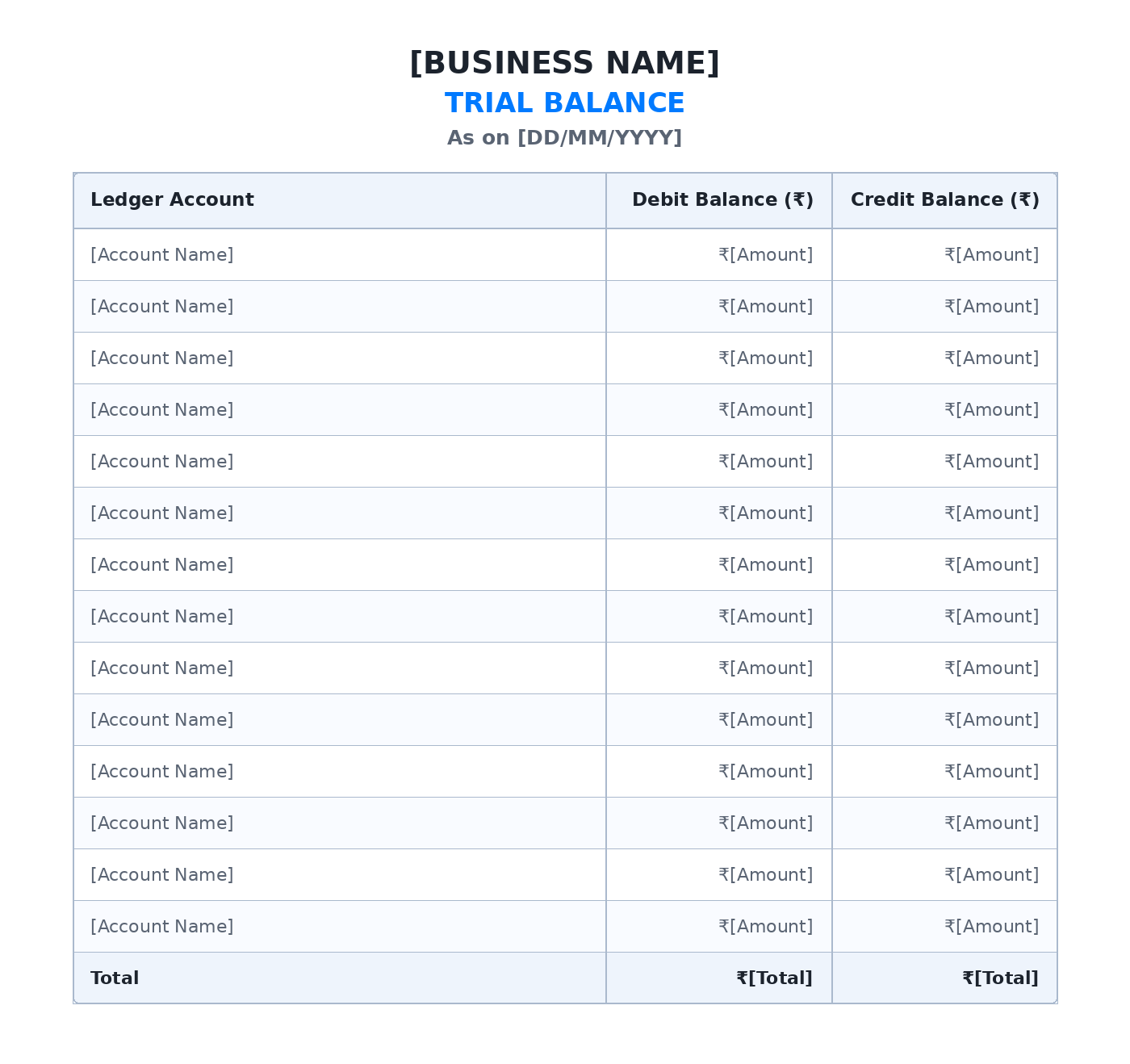
A simple trial balance format has three main columns: account name, debit balance, and credit balance. Each account appears once, either in the debit column or the credit column. At the end, the debit and credit column totals should be the same.
Which Accounts Usually Appear on the Debit and Credit sides?
Different types of accounts usually appear on different sides of the trial balance. Here is a simple way to understand it:
| Usually Appears on Debit Side | Usually Appears on Credit Side |
|---|---|
| Cash and bank balance | Capital introduced by the owner |
| Stock or inventory | Loans taken by the business |
| Machinery and furniture | Creditors, meaning suppliers you have to pay |
| Debtors, meaning customers who owe you money | Sales |
| Purchases | Commission received |
| Rent, salaries and other expenses | Interest received |
| Drawings, meaning money taken out by the owner | Other income |
Usually Appears on Debit Side
Usually Appears on Credit Side
Usually Appears on Debit Side
Usually Appears on Credit Side
Usually Appears on Debit Side
Usually Appears on Credit Side
Usually Appears on Debit Side
Usually Appears on Credit Side
Usually Appears on Debit Side
Usually Appears on Credit Side
Usually Appears on Debit Side
Usually Appears on Credit Side
Usually Appears on Debit Side
Usually Appears on Credit Side
For example, if your customers still owe you ₹45,000, that amount appears as debtors on the debit side. If you have purchased goods from a supplier and still owe ₹40,000, that amount appears as a creditor on the credit side.
These are common patterns, but the actual side depends on how the account balance appears in your books. Your accountant can confirm the final classification while preparing the trial balance.
Trial Balance Example
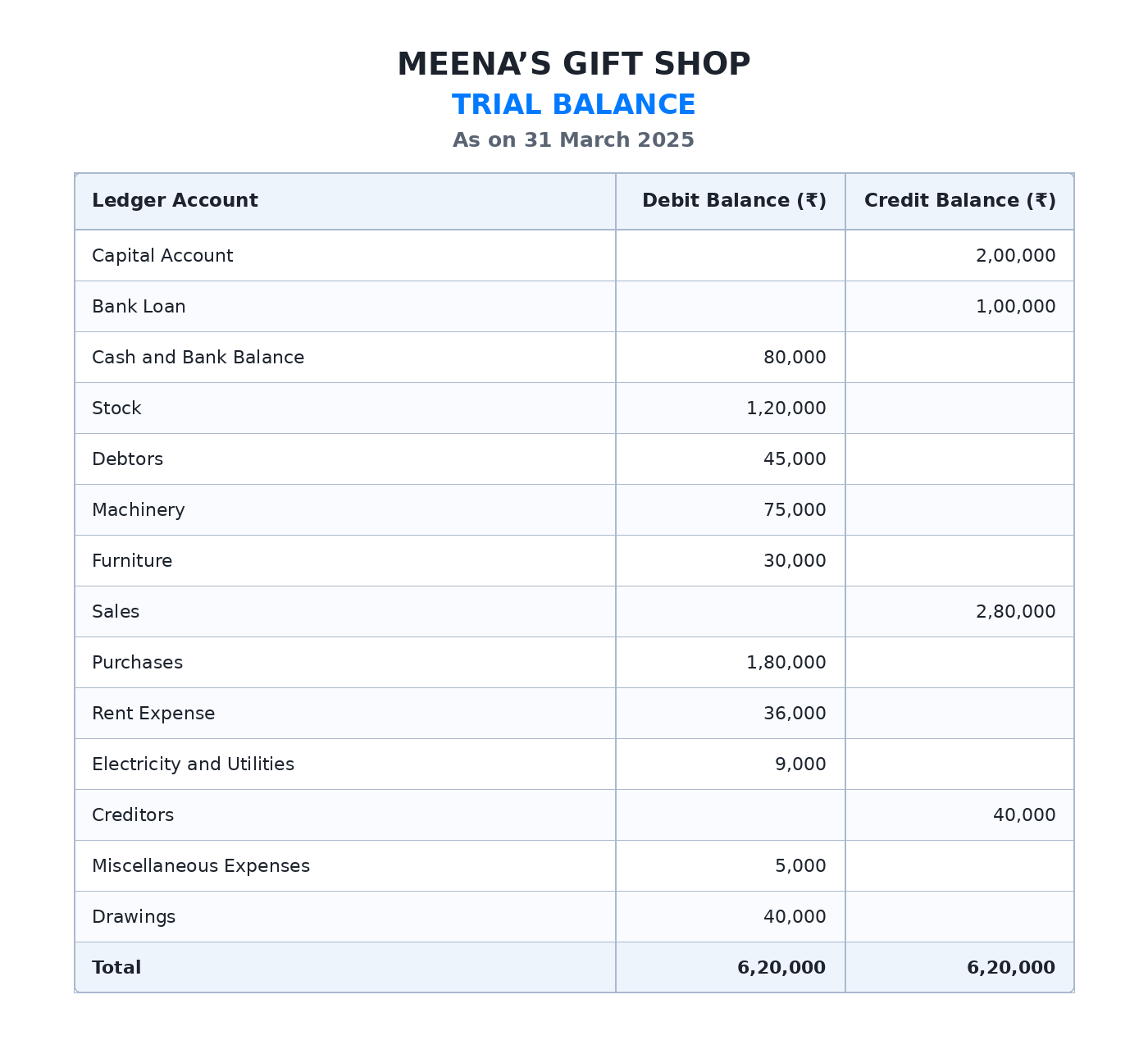
In this example, both sides total ₹6,20,000. This means the trial balance is ready for further review and final account preparation.
When Is a Trial Balance Prepared?
A trial balance can be prepared monthly, quarterly or annually. Many small businesses prepare it at the end of the financial year, usually on 31 March. However, preparing it more regularly can be useful. For example:
- A monthly trial balance helps track books more closely.
- A quarterly trial balance helps catch errors before they increase.
- A year-end trial balance helps prepare final accounts and tax-related reports.
If you are a new business owner, you may not need to prepare it yourself. But you should know how to read the basic report when your accountant shares it.
What Errors Can a Trial Balance Show or Miss?
A trial balance is useful because it helps identify basic posting and calculation errors. However, it does not catch every mistake. Some errors can cause the debit and credit totals to differ, while others may still leave the trial balance matching.
When the Trial Balance Does Not Match
If the debit and credit totals do not match, it means some entry, balance, or total needs to be checked. The difference may be small or large, but it should be corrected before final accounts are prepared.
| Possible Cause | Simple Example |
|---|---|
| One side of an entry was missed | A payment was recorded in the cash account, but the related expense account was not updated. |
| A wrong amount was entered | ₹5,400 was entered as ₹4,500, or ₹7,200 was entered as ₹2,700 by reversing digits. |
| A ledger balance was copied incorrectly | The rent account balance was ₹36,000, but it was copied as ₹30,000 in the trial balance. |
| A transaction was posted to the wrong side | An amount that should have been debited was entered on the credit side. |
| A total was calculated incorrectly | The total of an expense account was added incorrectly before being taken to the trial balance. |
Possible Cause
Simple Example
Possible Cause
Simple Example
Possible Cause
Simple Example
Possible Cause
Simple Example
Possible Cause
Simple Example
When the trial balance does not match, your accountant checks the entries, ledger balances, and totals to find the difference. Once the error is corrected, the debit and credit totals should match again.
When the Trial Balance Matches but Still Has Errors
A matching trial balance means the debit and credit totals are equal. However, it does not prove that every entry is correct. Some mistakes may still remain because they do not change the total of both sides.
| Possible Error | Why the Trial Balance May Still Match |
|---|---|
| A transaction was recorded in the wrong account | The debit and credit entries were both made, but under the wrong account head. |
| A sale was missed completely | Since the sale was not recorded, neither a debit nor a credit was affected. |
| An expense was recorded under the wrong expense head | The total expense may still be recorded, but under the wrong category. |
| GST or tax entry was classified incorrectly | The amount may still be recorded, but the GST, tax payable, or input tax credit treatment may need separate checking. |
| A personal expense was treated as a business expense | The entry may balance, but the classification may be incorrect. |
Possible Error
Why the Trial Balance May Still Match
Possible Error
Why the Trial Balance May Still Match
Possible Error
Why the Trial Balance May Still Match
Possible Error
Why the Trial Balance May Still Match
Possible Error
Why the Trial Balance May Still Match
That is why a trial balance should be treated as a useful checking report, not as proof that the accounts are perfect. Your accountant may still need to review invoices, bank records, GST details, tax entries, and account classifications separately.
Conclusion
A trial balance helps organise all account balances in one place before final accounts are prepared. It gives your accountant a starting point for reviewing the books, identifying basic errors, and preparing reports such as the profit and loss statement and balance sheet.
It is not complete proof that the accounts are perfect, but it helps small business owners understand their books better and ask the right questions during year-end accounting discussions.