E-way Bill Basics for Small Businesses: When and Why It Is Needed
If you run a small business that buys, sells, or moves goods, the e-way bill is an important GST document to understand. Many business owners come across it only when a transporter asks for it, or when goods are stopped for checking during transit. The confusion usually starts because an invoice and an e-way bill are often treated as the same thing.
Quick summary
- An e-way bill is a digital goods transport document used under GST.
- It usually applies when the consignment value exceeds ₹50,000.
- It may be required for sales, stock transfers, returns, job work, exhibition goods, and other business movements.
- For road transport, the e-way bill should be generated before goods start moving.
- The e-way bill does not replace the invoice, bill of supply, or delivery challan.
- If goods are moved without a valid e-way bill when required, the goods and the vehicle may be detained.
- Some goods, transport modes, and situations are exempt.
- Important updates include Ship-to GSTIN in Bill-to/Ship-to cases, voluntary e-way bill closure, and two-factor authentication.
They are not the same. An invoice records the sale or supply, while an e-way bill records the movement of goods. Under GST, an e-way bill may be required when goods cross the applicable value limit, even if the movement is only a stock transfer between your own branches, godowns, or warehouses.
This guide explains what an e-way bill is, when it is required, what the e-way bill limit is, who should generate it, what documents are needed, and what can happen if you move goods without it.
What Is an E-Way Bill?
An e-way bill is a digital document generated on the government e-way bill portal for the movement of goods under GST. It acts as a GST record for goods movement. Once generated, the system provides a 12-digit e-way bill number, also called EBN. This number should be available with the driver, transporter, or person in charge of the goods during transit. In simple terms, an e-way bill indicates that the movement of goods has been recorded under the GST system before dispatch, wherever required.
What Is the E-way Bill Limit?
The general e-way bill limit is ₹50,000. This means an e-way bill is usually required when the consignment value of goods exceeds ₹50,000. For example, if goods worth ₹35,000 are being moved, an e-way bill may not be required under the general rule. But if goods worth ₹75,000 are being moved, an e-way bill is generally required.
The consignment value usually includes the taxable value and GST charged in the invoice, bill of supply or delivery challan. If the same document includes both taxable and exempt goods, the value of exempt goods is excluded from this calculation.
However, the ₹50,000 limit is not the only thing to check. Some special cases, such as inter-state job work movement and certain inter-state handicraft goods movement, may require an e-way bill even below ₹50,000.
Intra-state rules can also vary by state. Some states may have different limits or exemptions for movement within the same state. So, before moving goods locally, check the applicable state rule if there is any doubt.
When Is an E-Way Bill Required?
The e-way bill requirement is not limited to sales. It can also apply when goods are moved for stock transfer, return, job work, exhibition, demo, or other business purposes.
| Situation | What It Means | Example |
|---|---|---|
| Sale or purchase | Goods are sold or bought and transported | Goods worth ₹80,000 are sold from Delhi to Jaipur |
| Stock transfer | Goods are moved between your own shop, branch, warehouse or godown | Stock worth ₹1,20,000 is moved from a shop to a warehouse |
| Return of goods | Goods are returned to a supplier or sent back by a customer | Damaged goods worth ₹60,000 are returned to the supplier |
| Job work | Goods are sent for processing, finishing, repairing, packing or manufacturing support | Fabric is sent to another unit for stitching |
| Exhibition or demo | Goods are moved for display, demo, approval or trade fair use | Furniture samples are sent to an exhibition |
Situation
What It Means
Example
Situation
What It Means
Example
Situation
What It Means
Example
Situation
What It Means
Example
Situation
What It Means
Example
For inter-state job work movement, the e-way bill rule is different. If goods are sent by a principal in one State or Union Territory to a job worker in another State or Union Territory, the e-way bill must be generated by the principal or the registered job worker, irrespective of the consignment value.
Who Can Generate the E-Way Bill?
The person responsible for generating the e-way bill depends on who causes the movement of goods. In many small business transactions, the supplier generates it before dispatch. In other cases, the buyer or transporter may generate it.
| Party | When They Usually Generate It |
|---|---|
| Registered supplier | When goods are sold or dispatched by them |
| Registered buyer | When goods are received from an unregistered supplier |
| Transporter | When the supplier or buyer has not generated it and goods are handed over for transport |
| E-commerce operator or courier agency | In authorised cases where goods are moved through them |
Party
When They Usually Generate It
Party
When They Usually Generate It
Party
When They Usually Generate It
Party
When They Usually Generate It
What Details Are Needed to Generate an E-Way Bill?
To generate an e-way bill correctly, you need the invoice, goods, recipient, and transport details. Keeping them ready before dispatch helps avoid last-minute errors.
- GSTIN of the supplier
- GSTIN of the recipient, if registered
- Delivery address and PIN code
- Invoice, bill of supply or delivery challan number
- Invoice or document date
- Value of goods
- HSN code
- Reason for movement
- Transporter details, if goods are sent through a transporter
- Vehicle number, if goods are moved by road
- Transport document number, if goods are moved by rail, air or ship
Small errors in these details can create problems during checking. For example, an incorrect vehicle number or invoice value, or a mismatch in the goods description can raise questions during transit.
Part A and Part B of the E-Way Bill
An e-way bill has two important parts: Part A and Part B. Part A contains the goods and transaction details, while Part B contains the transport details.
Part A includes details such as supplier information, recipient information, invoice or challan number, goods value, HSN code, place of delivery and reason for transport. In simple words, Part A explains what goods are being moved, who is sending them, who is receiving them and why the goods are being transported.
Part B contains the transport details. For road transport, this usually means the vehicle number. For rail, air, or ship, it may include the transport document number.
For road movement, the e-way bill is generally not valid unless Part B is filled, except in specific short-distance cases allowed under the rules. If goods are shifted from one vehicle to another during the journey, Part B should be updated with the new vehicle details before the goods continue moving.
How to Generate an E-Way Bill
An e-way bill can be generated on the official e-way bill portal when goods are being moved from one place to another. The process mainly involves entering transaction details, party details, item details and transport details.
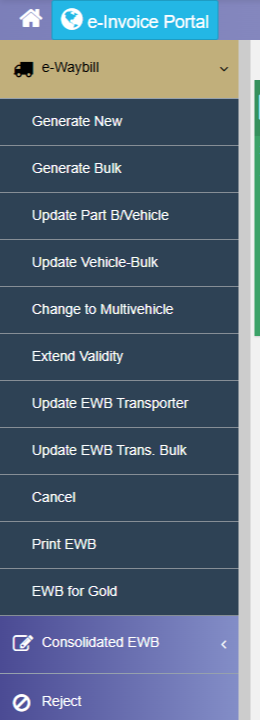
1. Log in and select Generate New
First, log in to the e-way bill portal using your GST login details. From the left-side menu, go to e-Waybill and select Generate New. This opens the e-way bill entry form.
2. Enter transaction and document details
In the transaction details section, select the supply type, such as Outward or Inward. Then choose the sub type based on the purpose of movement, such as supply, export, job work or own use.
Next, enter the document details. This includes the document type, document number and document date. For example, the document type may be a tax invoice, delivery challan or bill of supply, depending on the movement.

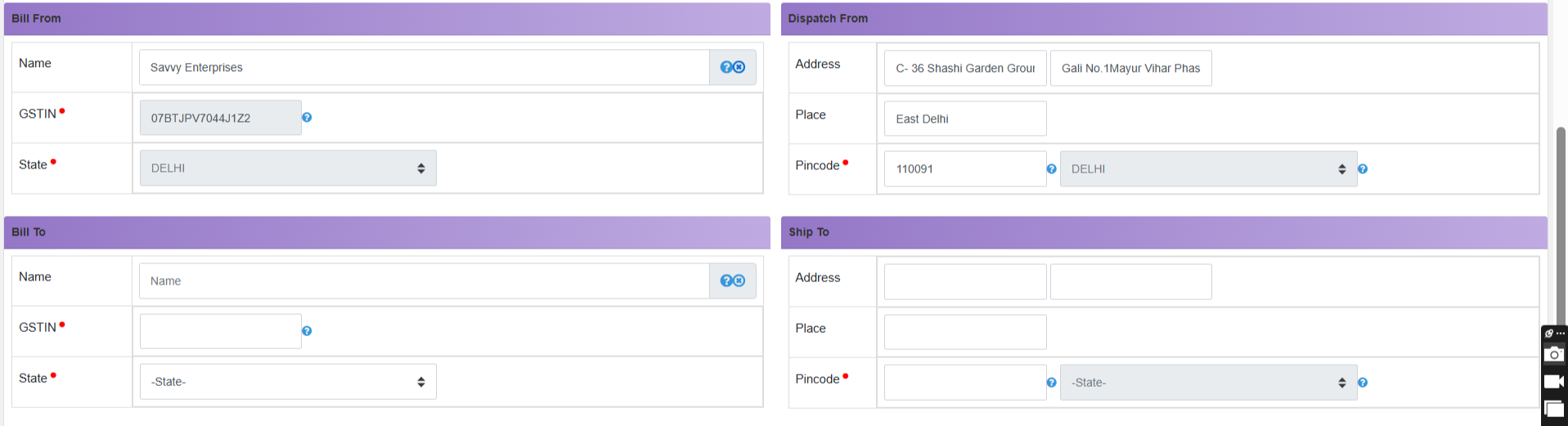
3. Add supplier and recipient details
After entering the transaction details, fill in the party details. The Bill From section contains the supplier’s GSTIN, name and state.
Then fill in the Bill To section with the recipient’s name, GSTIN and state. If the goods are being dispatched from or shipped to a different location, enter those details in the Dispatch From and Ship To sections.
4. Add goods and item details
In the item details section, enter the product name, description, HSN code, quantity, unit and taxable value. Also select the applicable GST rate.
The portal calculates the tax amounts based on the values entered. Review the total taxable amount, tax amount and total invoice value before moving ahead.

5. Add transport details and Part-B information
Next, enter the transport details. You may need to add the transporter ID, transporter name, approximate distance and mode of transport.
In Part-B, enter the vehicle number if the goods are moving by road. If the goods are being moved by rail, air or ship, enter the relevant transport document number and date.

6. Preview, submit and share the e-way bill
After filling in all required details, click Preview to review the form. Check the GSTIN, invoice details, item value, tax rate, distance and vehicle details carefully. Once everything is correct, click Submit. The portal will generate a 12-digit e-way bill number.
Latest E-Way Bill Updates
Small businesses should also know the latest e-way bill system updates, especially if they use billing software, ERP, API integration, or third-party transporters.
Ship-to GSTIN in Bill-to/Ship-to Cases
GSTN’s May 2026 update makes Ship-to GSTIN mandatory in Bill-to/Ship-to transactions. A Bill-to/Ship-to case happens when the billing party and the delivery location are different.
For example, a company’s head office is billed in Delhi, but the goods are delivered to its warehouse in Haryana. In this case, the billing address and delivery address are different. If the consignee is registered, the Ship-to GSTIN should be entered. If the consignee is unregistered, “URP” (unregistered person) should be entered in the Ship-to GSTIN field.
Voluntary E-Way Bill Closure
GSTN has introduced a voluntary e-way bill closure facility. This allows the e-way bill to be closed once the goods have been delivered. The e-way bill can be closed by the supplier, recipient, transporter, or an authorized person as per the portal process. Closure can be done on the same day of delivery or the next day.
This helps businesses and transporters show that the movement has been completed and the goods have reached the delivery location.
Two-Factor Authentication
Two-factor authentication is mandatory for taxpayers and transporters on the e-way bill system. This means businesses should make sure that the person handling e-way bill generation has proper login access and access to the registered mobile number or authentication method.
For small businesses, this is important because the e-way bill process may get delayed if the OTP or login access is with someone else.
How Long Is an E-Way Bill Valid?
The validity of an e-way bill depends on the distance the goods need to travel and the type of cargo.
| Distance and Cargo Type | Validity |
|---|---|
| Regular cargo up to 200 km | 1 day |
| Regular cargo for every additional 200 km or part of it | 1 additional day |
| Over-dimensional cargo up to 20 km | 1 day |
| Over-dimensional cargo for every additional 20 km or part of it | 1 additional day |
Distance and Cargo Type
Validity
Distance and Cargo Type
Validity
Distance and Cargo Type
Validity
Distance and Cargo Type
Validity
Over-dimensional cargo means cargo that exceeds the normal size limits under motor vehicle rules. Most small businesses deal with regular cargo, not over-dimensional cargo. If a vehicle is delayed, check the e-way bill validity before it expires and extend it within the allowed time window, where applicable.
When Is an E-Way Bill Not Required?
An e-way bill is not required for every goods movement. Some exemptions depend on the value of goods, mode of transport, type of goods and purpose of movement. In general, an e-way bill may not be required in these cases:
| Situation | When It Applies |
|---|---|
| Goods below the limit | When the consignment value does not exceed ₹50,000, except in specific cases such as inter-state job work or notified handicraft goods movement |
| Non-motorised transport | When goods are moved by hand cart, cycle cart, animal cart or another non-motorized vehicle |
| Exempt goods | When goods are covered under the e-way bill exemption list or are fully exempt, subject to applicable rules |
| Customs-related movement | When goods move under a customs bond, customs seal, or customs supervision |
| Weighbridge movement | When goods move up to 20 km from the consignor’s place of business to a weighbridge and back, with a proper delivery challan |
| State-specific exemptions | When a state has notified a different limit or exemption for intra-state movement |
Situation
When It Applies
Situation
When It Applies
Situation
When It Applies
Situation
When It Applies
Situation
When It Applies
Situation
When It Applies
These exemptions should be checked carefully before dispatch. Do not assume that every low-value, exempt, or local goods movement is automatically outside e-way bill rules.
What Documents Should Travel with the Goods?
An e-way bill is one part of the transport paperwork. During movement, the person in charge of goods should usually carry:
- Tax invoice, bill of supply or delivery challan
- E-way bill number or copy of the e-way bill, where required
- Transport document, if goods are moved by transporter, rail, air, or ship
- Any other document required for that specific goods movement
For job work, stock transfer or return of goods, a delivery challan may be used instead of a tax invoice, depending on the case.
What Happens If You Do Not Have an E-Way Bill?
If goods are moved without a valid e-way bill when required, tax officers can stop and inspect them in transit. If there is a violation, the goods and vehicle may be detained or seized. The business may also have to pay a penalty before the goods are released.
The penalty depends on the case, the type of goods, the tax payable, and whether the goods' owner comes forward to pay. The problem is not only the penalty. A detained vehicle can delay delivery, block payment, upset the customer, and increase transport cost. That is why small businesses should make e-way bill checking a fixed part of their dispatch process.
Common E-Way Bill Mistakes to Avoid
Even after understanding the basic rules, small errors can still create problems during transport. Before dispatch, avoid these common mistakes:
| Mistake | Why It Can Create a Problem |
|---|---|
| Moving goods with only an invoice | An invoice may not be enough if an e-way bill is required |
| Assuming the transporter will generate it | The responsibility should be clear before goods are handed over |
| Entering the wrong vehicle number | Vehicle details should match the actual vehicle carrying the goods |
| Not updating Part B after vehicle change | The e-way bill should show the latest vehicle details during movement |
| Ignoring stock transfers | Goods may need an e-way bill even when there is no sale |
| Generating it after dispatch | The e-way bill should be generated before goods start moving |
Mistake
Why It Can Create a Problem
Mistake
Why It Can Create a Problem
Mistake
Why It Can Create a Problem
Mistake
Why It Can Create a Problem
Mistake
Why It Can Create a Problem
Mistake
Why It Can Create a Problem
Practical Tips for Small Business Owners
Train the Person Handling Dispatch
Many business owners depend on staff, warehouse workers, or transport coordinators for dispatch. Make sure they know when an e-way bill is needed and who will generate it.
Keep Login and OTP Access Ready
Since two-factor authentication is required on the e-way bill system, ensure the person generating the e-way bill has both login and OTP access.
Save E-Way Bill Records
Keep generated e-way bills with invoices and delivery records. These records can help during GST audits, customer disputes or transport-related queries.
Keep Business Records Organized
As dispatches increase, it becomes harder to manually track invoices, challans, stock movements, and transport details. A simple business management tool like mazu can help keep billing, purchases, stock, and records organized in one place, so it becomes easier to check details before goods are dispatched.
Conclusion
An e-way bill is an important GST document for businesses that move goods. For small businesses, the safest approach is to check the e-way bill requirement before every dispatch. Before goods leave your shop, warehouse or godown, check the goods value, reason for movement, transport details, Ship-to details and state-level rules.
Once this becomes part of your dispatch process, it becomes easier to avoid penalties, vehicle detention and delivery delays.