Delivery Challan Meaning, Format, and Use in Business
Once your business starts moving goods regularly, you may not always raise an invoice at the time of dispatch. Goods may be sent for approval, job work, repair, exhibition, demo, or movement between business locations. In such cases, the goods still need a document during transport. This document is called a delivery challan.
Quick summary
- A delivery challan is a document used when goods are moved without a tax invoice being issued at the time of dispatch.
- It records the movement of goods, not a sale or payment.
- Under GST, a delivery challan is required in specific cases such as job work, goods sent on approval, and movement of goods for reasons other than supply.
- It should be tracked until the goods are returned, invoiced, transferred, or otherwise closed.
- A delivery challan does not replace a tax invoice. If a sale is confirmed later, the tax invoice must be raised separately.
This guide explains when to use a delivery challan, what details it should include, how it connects with e-way bills, and how to track it after dispatch.
What Is a Delivery Challan?
A delivery challan is a document issued by the sender when goods are transported without issuing a tax invoice at that time. It is also commonly called a delivery note or goods delivery challan. It travels with the goods and serves as proof that a specific quantity of goods was sent from one place to another.
When the goods arrive, the receiver can check the items against the delivery challan to confirm that everything has been received correctly. In simple terms, it proves dispatch and receipt of goods. It does not prove that a sale has happened.
Delivery Challan vs Tax Invoice
Many small business owners get confused about the difference between a delivery challan and a tax invoice. Both are business documents, but they are not used for the same purpose. The simple difference is this: a delivery challan shows that goods have moved. A tax invoice shows that a sale or taxable supply has happened.
| Particulars | Delivery Challan | Tax Invoice |
|---|---|---|
| Main purpose | Records movement of goods | Records sale or taxable supply |
| When it is issued | When goods move without an invoice | When goods or services are sold |
| Payment due | No payment is due only because of the challan | Payment is usually due as per invoice terms |
| GST liability | Not triggered by the challan alone | GST liability applies where the supply is taxable |
| ITC use | Cannot be used to claim ITC | Can be used to claim ITC, if eligible |
| Used for | Job work, approval goods, stock movement, exhibitions, and demo movement | Sales, taxable supplies, and billing |
Particulars
Delivery Challan
Tax Invoice
Particulars
Delivery Challan
Tax Invoice
Particulars
Delivery Challan
Tax Invoice
Particulars
Delivery Challan
Tax Invoice
Particulars
Delivery Challan
Tax Invoice
Particulars
Delivery Challan
Tax Invoice
Note: ITC means input tax credit. It is the GST credit that a registered buyer may claim on eligible business purchases.
Delivery Challan vs E-Way Bill
A delivery challan and an e-way bill are not the same document. A delivery challan records why goods are moving without an invoice. An e-way bill is generated on the GST system for movement of goods where e-way bill rules apply.
When goods are delivered without an invoice, the delivery challan can serve as the base document for generating the e-way bill. Important points to remember:
- A delivery challan can be used to generate an e-way bill when no tax invoice is issued.
- The e-way bill number should be mentioned on the delivery challan, where applicable.
- If goods are sent by a principal to a job worker in another state or Union Territory, an e-way bill is required even if the consignment value is below ₹50,000.
- For intra-state movement, some rules may vary by state. Always check the current rules for your state.
- Some goods and movements may be exempt from e-way bill requirements.
When Is a Delivery Challan Required?
Under GST, a delivery challan is required in specific cases where goods are transported without issuing a tax invoice at the time of movement.
1. Goods Sent for Job Work
Job work means sending your goods to another person for processing, finishing, repair, packing, testing, or any other work. For example, a garment business may send fabric for stitching, or a manufacturer may send parts for polishing.
Since the goods are not being sold to the job worker, a tax invoice is not raised at the time of dispatch. A delivery challan is used to record the movement. When processed goods are returned or supplied further as per GST rules, the original delivery challan helps track their movement.
For job work, also track return timelines. Inputs should generally be brought back or supplied further within one year, and capital goods within three years, subject to GST conditions.
2. Goods Sent on Approval or Sale-or-Return Basis
Sometimes goods are sent to a customer, dealer, or agent for approval. The buyer may keep the goods or return them later. In this case, a sale is not confirmed at the time of dispatch. So, a delivery challan is used when the goods are sent.
If the buyer accepts the goods, a tax invoice should be raised before or at the time of supply, or within six months from the date of removal, whichever is earlier.
3. Liquid Gas Supply Where Quantity Is Not Known
For some supplies, such as liquid gas, the exact quantity may not be known when the goods are removed from the sender’s location. In such cases, a delivery challan can be issued first. Once the actual quantity is known, the tax invoice can be raised with the correct details.
4. Goods Sent in Batches, Lots, or Knocked-Down Condition
Some goods are too large or too complex to move in a single shipment. They may be sent in batches, lots, semi-knocked-down condition, or completely knocked-down condition.
For such movement, the complete invoice should be issued before the first consignment is dispatched. Each subsequent consignment can be moved with a delivery challan that refers to the original invoice. A certified copy of the invoice should also accompany each consignment, and the original invoice should be sent with the last consignment.
This is different from a normal challan-only movement because the invoice is already raised before the first shipment.
5. Goods Moved for Reasons Other Than Supply
A delivery challan may be used when goods are moved for reasons other than sale or supply. Examples include:
- Goods sent for repair
- Goods sent for demonstration
- Goods sent to an exhibition
- Samples sent for display
- Tools, equipment, or material moved temporarily
- Stock movement between locations under the same GSTIN
Be careful with branch transfers. If goods are moved between locations under the same GSTIN and there is no supply, a delivery challan may be used. But if goods move between separate GST registrations, even within the same business, a tax invoice may be required because GST treats them as distinct persons.
When in doubt, check with your accountant or CA before treating a branch transfer as a challan-only movement.
Delivery Challan Example: Fabric Sent for Job Work
Suppose a garment business sends 100 metres of fabric to a stitching unit for job work. Since the fabric is not being sold to the stitching unit, the business does not raise a tax invoice at the time of dispatch.
Instead, it prepares a delivery challan with the fabric description, quantity, value, job worker details, purpose of dispatch, transport details, and signature. The challan travels with the goods and is recorded in the business’s stock records.
Once the stitching work is completed, the finished goods may either be returned to the business or supplied further as per GST rules. The business should then update the challan status, stock record, and related job work record. If a sale happens later, the tax invoice should be raised separately.
This simple tracking helps the owner know what was sent, where it went, whether it came back, and whether any invoice is still pending.
What Should a Delivery Challan Include?
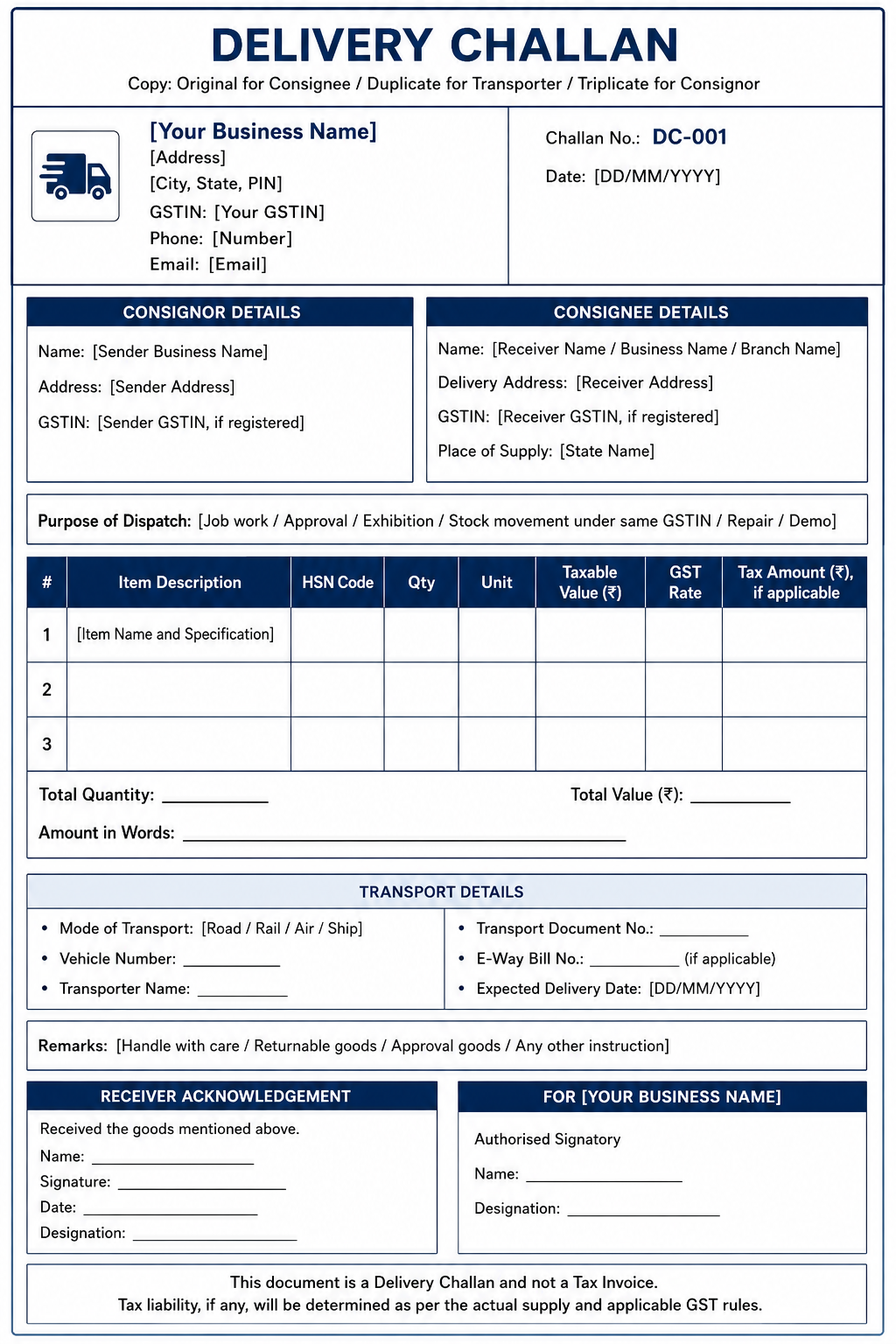
A proper delivery challan format should include all important details about the sender, receiver, goods, transport, and purpose of movement. These details help identify the goods, explain why they are being moved, and avoid confusion with a tax invoice.
1. Title of the Document
The document should clearly mention “Delivery Challan” at the top. This helps distinguish it from a tax invoice, proforma invoice, purchase order, or quotation.
2. Challan Number and Date
Every delivery challan should have a unique serial number and date. For example, you can use a simple series like DC-001, DC-002, and DC-003. Keep the delivery challan number series separate from your invoice number series. This makes tracking easier and avoids confusion during record checks.
3. Sender Details
Mention the details of the consignor. Consignor means the person or business sending the goods. The sender details usually include the business name, address, GSTIN (if registered), contact number, and email address (if required).
4. Receiver Details
Mention the details of the consignee. Consignee means the person or business receiving the goods. The receiver details usually include the receiver's name, delivery address, GSTIN (if registered), and contact person (if required).
5. Place of Supply
Place of supply means the GST location used to decide whether CGST and SGST, or IGST, applies. For inter-state movement, the place of supply should be clearly stated. This helps avoid confusion during GST checks and e-way bill generation.
6. Purpose of Dispatch
Mention why the goods are being sent. This is one of the most important fields because it explains why a tax invoice is not being raised at the time of dispatch.
7. Description of Goods
The delivery challan should clearly mention what goods are being transported. This helps the receiver, transporter, and tax authorities correctly identify the goods.
The description of goods should include the item name, description or specification, HSN code where applicable, quantity, unit of measurement, taxable value, GST rate where applicable, and tax amount where applicable.
Taxable value means the value on which GST would be calculated if tax applies. Even if no tax is collected at this stage, the value of goods should be mentioned for GST and transport records.
8. Transport Details
Transport details show how goods are moved from one place to another. You can include the mode of transport, vehicle number, transporter name, LR number or transport document number (if available), e-way bill number (if applicable), and expected delivery date.
9. Signature and Acknowledgement
The delivery challan should be signed by the sender or an authorised person. This confirms that the goods have been dispatched under proper approval. At the time of delivery, it is also useful to get the receiver’s name, signature, date, and designation.
Delivery Challan Format
How Many Copies of a Delivery Challan Are Needed?
A delivery challan is generally prepared in three copies. This helps the sender, transporter, and receiver keep a clear record of the movement.
| Copy | Given To | Purpose |
|---|---|---|
| Original | Consignee | For the receiver of goods |
| Duplicate | Transporter | For transport records during movement |
| Triplicate | Consignor | For the sender's business records |
Copy
Given To
Purpose
Copy
Given To
Purpose
Copy
Given To
Purpose
If you send goods first and invoice later, mazu can help small businesses keep billing and payment records organised, so it is easier to follow what has been invoiced, paid, and still pending.
What Happens After a Delivery Challan?
A delivery challan should not remain open forever. Once the goods are dispatched, you need to track what happened next and close the challan properly in your records.
1. Confirm That the Goods Were Received
First, confirm that the receiver has accepted the goods. The receiver’s name, signature, date, and designation should be recorded wherever possible. This helps prove that the goods reached the intended recipient or location, especially if there is a later dispute over quantity, condition, or delivery date.
2. Update Your Stock Records
Once the goods move out, update your inventory records. If the goods are returned later, update the stock again when they come back. This is important for job work, repairs, demonstrations, exhibitions, approval of goods, and movement between your own locations.
3. Decide Whether an Invoice Is Needed
A delivery challan only records the movement of goods. It does not replace a tax invoice. If the goods are later sold, accepted by the buyer, or treated as a taxable supply, raise the tax invoice as per GST rules. If the goods are returned, record the return rather than raising an unnecessary invoice.
4. Use a Simple Challan Status System
Each delivery challan should show its stage. This helps you quickly see which challans are still pending and which ones are already settled. You can use simple statuses such as:
- Open: Goods have been dispatched, but the next action is pending.
- Received: The receiver has acknowledged the goods.
- Returned: The goods have been returned in full.
- Partially returned: Only part of the goods has come back.
- Invoiced: The goods have been accepted or sold, and an invoice has been raised.
- Closed: No further action is pending.
The exact status names can vary, but every challan should clearly show whether it still needs follow-up.
5. Link the Challan With the Final Record
Before closing the challan, link it with the correct final record. This may be a return entry, stock transfer record, job work completion record, repair note, or tax invoice.
6. Keep the Challan for Records
Keep the delivery challan along with related documents such as e-way bill, transport receipt, return note, job work records, or tax invoice. This makes it easier to answer questions during GST checks, transport verification, stock reconciliation, or internal account review.
Common Mistakes to Avoid
A delivery challan may look simple, but problems usually happen when the actual movement of goods does not match the records. Here are some practical mistakes to avoid.
1. Sending Goods Without Internal Approval
Do not issue a delivery challan solely because someone requested the goods verbally. For job work, approvals, repairs, demos, or branch movement, keep a basic approval trail. This can be a purchase request, job work instruction, customer approval request, email, WhatsApp confirmation, or internal dispatch note. It helps show why the goods were sent.
2. Not Marking Goods as Returnable or Non-Returnable
Some goods are expected to be returned, while others may be accepted, sold, consumed, or permanently transferred. If this is not clear, your team may not know whether to follow up for return or billing. For example, goods sent for repair or demo should usually be tracked as returnable. Goods sent on approval should be tracked until the buyer accepts or returns them.
3. Sending More or Less Quantity Than Mentioned
Sometimes the challan is prepared for one quantity, but the warehouse dispatches a different quantity. This creates a mismatch between the document, physical goods, and stock records. Before dispatch, the packed quantity should be checked against the challan quantity. If there is a change, update the challan before the goods move.
4. Not Recording Partial Delivery or Short Receipt
The receiver may receive only part of the goods or find a shortage at the time of delivery. If this is not recorded immediately, it becomes difficult to prove what actually happened. Any shortage, damage, or partial receipt should be noted in the acknowledgement or in a linked delivery note.
5. Using One Challan for Unrelated Movements
Avoid using a single delivery challan for different dispatches to different places, receivers, or purposes. It may look easier at the time, but it makes tracking harder later. Each challan should clearly match one movement or a connected dispatch process.
6. Not Checking Whether Goods Actually Returned
For returnable goods, do not rely only on the original challan. Check whether the goods were physically returned, whether the quantity matches, and whether they are in usable condition. This is especially important for demo goods, repair items, exhibition stock, samples, and job work material.
Conclusion
A delivery challan is a simple but important document for businesses that move goods without raising an invoice at the time of dispatch. For small businesses, the key is to understand its role clearly. A challan tracks movement. An invoice confirms a sale or taxable supply.
Using the right document at the right stage keeps your dispatch, stock, GST, and billing records cleaner. Once a challan is issued, track the next action and close the record properly.