Cash Flow Statement Explained in Simple Words
In the first few years of business, many owners face the same problem. Sales look decent and the profit and loss statement shows profit, but the bank account still feels tight at the end of the month.
Supplier payments become stressful. Salaries need to be planned in advance. A new order comes in, but buying stock for it requires extra cash. A cash flow statement helps explain this gap by showing when money actually came in and when it went out.
Quick summary
- A cash flow statement shows how cash actually moved in and out of your business during a specific period.
- It is different from your profit and loss statement. You can show profit on paper and still face a cash shortage.
- It is divided into three sections: operating activities, investing activities, and financing activities.
- It helps you understand whether your business is generating real cash or depending on loans and advances.
- Even if your accountant prepares it, knowing how to read one helps you make better decisions about spending, borrowing, and growth.
What Is a Cash Flow Statement?
A cash flow statement is a financial report that tracks the movement of cash in and out of your business during a specific period. This period may be a month, quarter, or financial year.
The important word here is cash. It does not just look at sales, invoices, or bills. It looks at the money actually received and paid.
For example, if you raise an invoice today but the customer pays 45 days later, your cash flow statement will record the cash only when the payment is received. This makes it different from the profit and loss statement, which records income when it is earned and expenses when they are incurred.
In simple terms, a cash flow statement helps answer one practical question: Do you have enough cash available to run the business smoothly?
Cash Flow Statement vs Profit and Loss Statement: What Is the Difference?
This difference is important for small business owners because profit does not always mean available cash.
| Cash Flow Statement | Profit and Loss Statement | |
|---|---|---|
| What it shows | When cash actually moved | When income was earned, or an expense was recorded |
| Credit sales | Recorded only when the customer pays | Recorded when the invoice is raised |
| Unpaid supplier bills | Recorded only when you pay them | Recorded when the bill is entered |
| Main use | Shows whether you have enough cash available | Shows whether the business made a profit or a loss |
| Period covered | Month, quarter, or financial year | Month, quarter, or financial year |
Cash Flow Statement
Profit and Loss Statement
Cash Flow Statement
Profit and Loss Statement
Cash Flow Statement
Profit and Loss Statement
Cash Flow Statement
Profit and Loss Statement
Cash Flow Statement
Profit and Loss Statement
For example, you complete a project in March and raise an invoice of ₹5,00,000. The client pays you in May.
Your profit and loss statement will show ₹5,00,000 as income in March because that is when the invoice was raised. Your cash flow statement will show ₹5,00,000 in May because that is when the money was actually received.
So, in March, your business may look profitable. But if you had supplier payments, salaries, rent, or loan EMIs due in April, you may still face a cash shortage. This timing difference is what a cash flow statement makes clear.
The Three Sections of a Cash Flow Statement
A cash flow statement is usually divided into three parts: operating activities, investing activities, and financing activities. Together, these sections show whether cash came from regular business activity, asset-related decisions, or funding sources such as loans and owner capital.
| Section | What it means | Common cash movement |
|---|---|---|
| Operating Activities | Cash received and paid through regular business activity. | Customer payments, cash sales, supplier payments, rent, salaries, utilities, GST payments, and other regular tax payments, depending on the reporting format. |
| Investing Activities | Cash spent on or received from long-term business assets. | Purchase or sale of machinery, vehicles, computers, equipment, property, or other long-term assets. |
| Financing Activities | Cash related to how the business is funded. | Loans taken, loan repayments, owner capital, owner withdrawals, and dividend payments in case of companies. |
Section
What it means
Common cash movement
Section
What it means
Common cash movement
Section
What it means
Common cash movement
Cash Flow Statement Example for a Small Business
Here is a simplified cash flow statement for a small trading business.
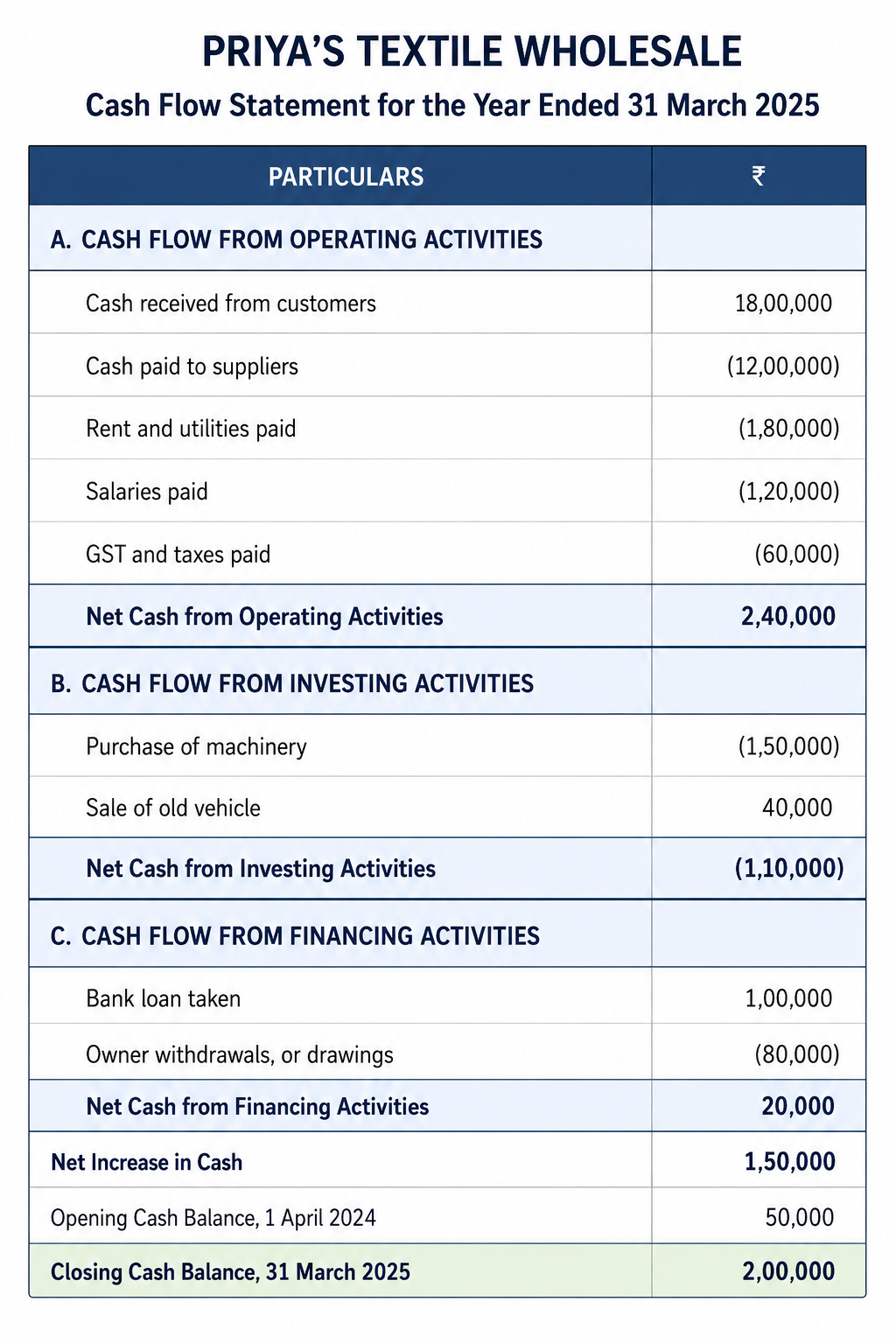
In this example, Priya's business generated ₹2,40,000 from regular operations. This is a good sign because the business is not depending only on loans or owner funds to keep running.
It also spent ₹1,50,000 on machinery and received ₹40,000 from the sale of an old vehicle. This resulted in a net cash outflow of ₹1,10,000 from investing activities.
The business also took a bank loan of ₹1,00,000 and the owner withdrew ₹80,000, leaving a net cash inflow of ₹20,000 from financing activities.
Overall, the business had a net cash increase of ₹1,50,000 during the year. The closing cash balance became ₹2,00,000.
What to Check in a Cash Flow Statement
You do not need deep accounting knowledge to use this report. As a business owner, focus on a few practical checks that show whether the business has enough cash to run smoothly.
Is Operating Cash Flow Positive?
Start with the operating activities section. If your business regularly generates positive cash from its core work, it means sales and collections are generating enough revenue to support daily operations.
If operating cash flow is regularly negative, check the reason. This may happen because of slow collections, faster supplier payments, high expenses, or excess stock.
Are Loans Being Used for Growth or Daily Expenses?
Next, look at the financing activities section. A loan taken to buy machinery, open a new branch, or expand capacity may be planned borrowing. But if loans are being used to pay rent, salaries, supplier bills, or other regular expenses, it needs closer attention.
Borrowing for daily operations can create pressure because the business must manage both regular expenses and repayments.
Where Is Cash Getting Blocked?
A cash flow statement can help you identify where money is getting stuck. For many small businesses, this happens because of delayed customer payments, excess stock, advance payments to suppliers, high monthly expenses, loan repayments, or owner withdrawals.
Once you know where the cash is blocked, you can take specific action. For example, you may tighten credit terms, reduce slow-moving stock, or plan supplier payments better.
Does the Closing Balance Match Your Actual Cash and Bank Balance?
The closing cash balance in the cash flow statement should reconcile with your actual cash in hand, bank balance, and other cash-equivalent balances, if any.
If there is a significant mismatch, your books may need to be checked. There may be missing entries, wrong payment records, duplicate entries, or cash transactions that were not recorded properly.
Why Profitable Businesses Can Still Face Cash Problems
A business can show profit and still struggle with cash. This is common in the first few years of business. Here are some common reasons.
- Customers take too long to pay: You may raise an invoice today, but if the customer pays after 60 or 90 days, your profit appears before your cash arrives.
- Suppliers need faster payment: Some suppliers may ask for advance payment or shorter credit periods. This means cash leaves before you receive money from customers.
- Stock blocks cash: Businesses often buy extra stock before festivals, seasons, or large orders. Until that stock is sold and money is collected, your cash stays blocked.
- Loan EMIs reduce cash: Equated Monthly Installment (EMI) payments reduce cash every month. In the profit and loss statement, only the interest part is treated as an expense. But the full EMI still affects your bank balance.
- Owner withdrawals are not always visible as expenses: If the owner regularly withdraws money from the business, it reduces available cash even though it may not appear as a normal business expense.
Is a Cash Flow Statement Required for Small Businesses in India?
Under the Companies Act, 2013, a cash flow statement is generally included as part of a company’s financial statements. However, certain companies, such as One Person Companies (OPCs), small companies, dormant companies, and eligible recognised start-up private companies, may not need to include it.
For sole proprietors and partnership firms, there is no specific company-law requirement to prepare a cash flow statement. However, a lender, investor, tax professional, or accountant may still ask for a cash flow report to better understand the business.
Applicability can depend on the business structure and current legal status, so business owners should confirm with their CA. Even if it is not legally required for your business, preparing one regularly is still useful.
If you want better control over customer payments, mazu can help you create invoices, record payments, and track pending amounts so your billing stays clear and organised.
Who Prepares a Cash Flow Statement?
For many small businesses in India, the cash flow statement is prepared by a Chartered Accountant at year-end as part of annual accounts.
If your business uses accounting software, a statement of cash flows may also be generated from recorded transactions. But the report will only be useful if the entries are accurate and up to date. If transactions are recorded late or cash payments are missed, the report may not show the real position.
For very small businesses, even a simple cash movement report can help track daily receipts, supplier payments, withdrawals, and closing cash balance before preparing a formal cash flow statement.
Common Mistakes Small Business Owners Make While Reading Cash Flow
Many owners look only at sales or profit and ignore cash movement. This can create confusion when the bank balance does not match the profit number. Here are a few common mistakes to avoid:
- Looking only at profit: Profit is important, but it does not show whether customers have actually paid.
- Ignoring receivables: If many customers owe you money, your sales may look good, but your cash may still be low.
- Treating all borrowing as growth: A loan used for expansion is different from a loan used to pay daily bills.
- Not tracking owner withdrawals: Regular withdrawals can quickly reduce business cash.
- Not reviewing cash flow regularly: Looking at cash flow only once a year may be too late. A quarterly or monthly review helps you spot delayed collections, rising expenses, and excess stock before they create a cash shortage.
Conclusion
A cash flow statement helps you see whether your business has enough cash to manage daily payments, supplier dues, stock purchases, loan repayments, and growth plans.
When used alongside your profit and loss statement, it provides a clearer picture of your business's health. One shows business performance, while the other shows actual cash movement.
Ask your accountant for your cash flow statement at least once a year. If your business has regular credit sales, supplier payments, stock purchases, or loan repayments, review it quarterly. If cash pressure is frequent, a monthly cash flow report can help you spot problems earlier.