Balance Sheet Explained for Small Business Owners
When your business has been running for some time, sales and bank balance are no longer enough to understand how well it is doing.
Quick summary
- A balance sheet shows your business’s financial position on a specific date.
- It follows one basic rule: Assets = Liabilities + Owner’s Equity.
- It helps you check debt, stock, customer dues, cash pressure, and loan readiness.
- The main parts of a balance sheet are assets, liabilities, and owner’s capital or equity.
- You do not need to be an accountant to understand the main numbers.
You may start asking bigger questions. Is the business actually growing? Is too much money stuck in stock? Are customers paying on time? Can you take a business loan safely? Is debt becoming difficult to manage?
This guide explains what a balance sheet means, how it is structured, and what small business owners should check in it.
What Is a Balance Sheet?
A balance sheet is a financial statement that shows the position of your business on a particular date, such as 31st March or the end of a quarter. It is different from a profit and loss statement. A profit and loss statement shows sales, expenses, and profit or loss over a period, such as a month, quarter, or year. A balance sheet shows where the business stands on one specific date.
For a small business owner, this is useful because strong sales do not always mean strong cash flow. Money may still be stuck in unpaid customer bills, unsold stock, or upcoming supplier payments.
Components of a Balance Sheet
A balance sheet has three main components: assets, liabilities, and owner’s capital or equity.
| Component | Types | What it includes |
|---|---|---|
| Assets Things that have value and belong to your business. | Current assets: Assets expected to be used, sold, or converted into cash within a year or within the normal business cycle. Non-current assets: Long-term assets used in the business for more than one year. | Cash in hand, bank balance, stock or inventory, money customers owe you, machinery, furniture, computers, vehicles, owned property, advance rent, or other prepaid expenses. |
| Liabilities Amounts your business owes to others. | Current liabilities: Amounts usually due within a year or within the normal business cycle. Non-current liabilities: Long-term obligations payable over a longer period. | Bank loans, supplier dues, unpaid GST, unpaid income tax, customer advances, short-term borrowings, or overdraft amounts. |
| Owner’s Capital or Equity The amount left after reducing liabilities from assets. | For sole proprietors, it is usually called owner’s capital or proprietor’s capital. For partnership firms, it is usually called partner’s capital. For companies, it may include share capital and retained profits. | Capital introduced by the owner or partners, retained profits, share capital, and accumulated business value after liabilities are considered. |
Component
Things that have value and belong to your business.
Types
Non-current assets: Long-term assets used in the business for more than one year.
What it includes
Component
Amounts your business owes to others.
Types
Non-current liabilities: Long-term obligations payable over a longer period.
What it includes
Component
The amount left after reducing liabilities from assets.
Types
What it includes
The Basic Rule of a Balance Sheet
A balance sheet follows one basic equation: Assets = Liabilities + Owner’s Equity
This means everything the business owns is funded either by borrowed money or by the owner’s capital. For example, suppose your business has:
- Assets: ₹10 lakh
- Liabilities: ₹4 lakh
- Owner’s equity: ₹6 lakh
In this case: ₹10 lakh = ₹4 lakh + ₹6 lakh
Now, suppose you take a ₹3 lakh bank loan to buy machinery. Your assets increase because the business now owns machinery. Your liabilities also increase because the business has a new loan.
Both sides increase together, so the balance sheet still matches. This is why both sides of a balance sheet must always balance.
What Does a Balance Sheet Format Look Like?
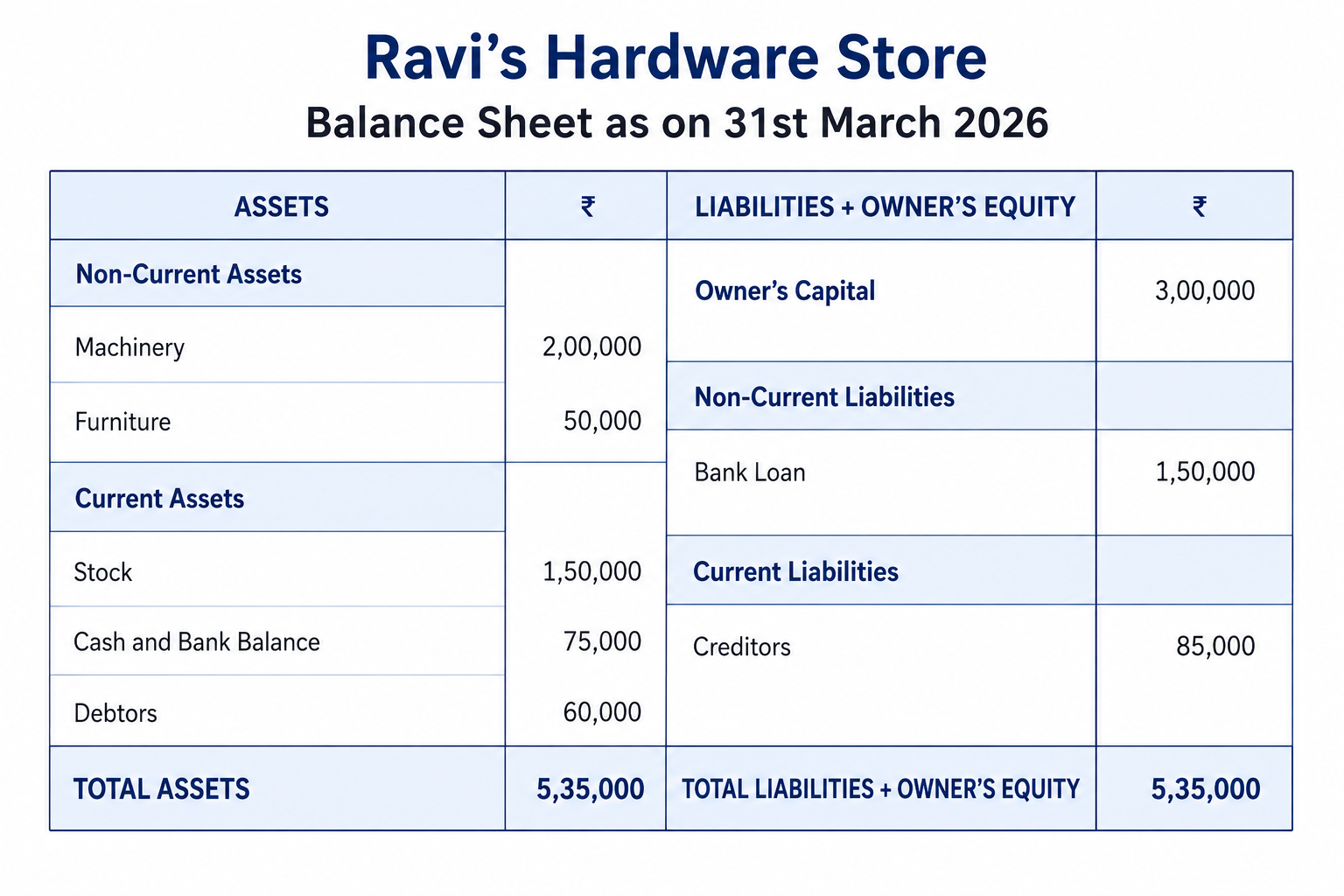
A balance sheet format usually presents assets, liabilities, and owner’s capital in a structured way. Most modern balance sheets follow a vertical format. In this format, items are listed one below another. This is easier to read and is commonly used by accountants. A traditional horizontal format may also be used. In this format, liabilities and capital appear on one side, while assets appear on the other side.
Companies covered under the Companies Act, 2013 generally prepare financial statements in the Schedule III format, unless a different format applies under another law or regulatory requirement. Sole proprietors and partnership firms may not follow the same statutory format, but accountants often use a similar structure for clarity.
For a small business owner, the format is less important than the items it shows. You will usually see capital, loans, creditors, debtors, closing stock, cash and bank balance, fixed assets, and tax dues.
These items help you understand where business funds are held, which payments are pending, and how much of the business’s value belongs to the owner.
In the example given above, total assets are ₹5,35,000. Total liabilities and owner’s equity are also ₹5,35,000. This means both sides of the balance sheet match.
What to Check in a Balance Sheet
You do not need to memorize accounting formulas to understand a balance sheet. Start with the numbers that affect debt, cash flow, stock, customer payments, capital, and loan readiness.
1. Is the Business Carrying Too Much Debt?
Start by looking at loans and other liabilities. If liabilities are increasing every year, check whether assets and owner’s capital are also increasing. Debt is not always bad. Many businesses use loans to expand. But debt becomes risky when the business is not generating enough value from it. Borrowing can support growth, but regular expenses should not depend only on new loans or supplier credit.
2. Can the Business Pay Short-Term Bills?
Compare current assets with current liabilities. Current assets include cash, bank balance, stock, and customer dues. Current liabilities include supplier dues, short-term loans, and unpaid taxes. If current liabilities consistently exceed current assets, the business may struggle to make payments on time. This can happen even when sales look good.
3. Is Too Much Money Stuck in Stock?
Stock is an asset, but it is not the same as cash. If your shop or godown has too much unsold stock, your money is blocked. This can affect your ability to pay suppliers, salaries, rent, or loan installments. This point is especially important for retailers, wholesalers, distributors, and trading businesses.
4. Are Customers Paying on Time?
The debtors figure shows how much money customers owe your business. If this number continues to grow, customers may be taking too long to pay. This can create cash flow pressure. A balance sheet can help you notice this problem early. You may then tighten credit terms, send payment reminders, or follow up more regularly.
5. Is the Owner’s Capital Improving?
Owner’s capital shows the owner’s stake in the business. If owner’s capital is improving over time, it can be a positive sign. But check the reason behind the increase. It may be due to retained profits, fresh capital introduced by the owner, or both. If owner’s capital is reducing, check why. It may be due to losses, high drawings, rising debt, or poor cash management.
6. Is the Business Ready for a Loan?
Banks and lenders may review your balance sheet along with bank statements, cash flow, repayment history, credit profile, tax records, and existing loans before approving a business loan. They may check whether your business has enough assets, manageable liabilities, stable capital, and repayment capacity. If you plan to apply for a loan, review your balance sheet with your accountant first.
If you want a clearer view of invoices, payments, and pending customer dues, a billing and invoicing app like mazu can help you keep key business records in one place. This makes it easier to track money coming in, money due, and payments still pending.
Who Prepares a Balance Sheet?
For many small businesses in India, the balance sheet is prepared by a Chartered Accountant or a qualified accountant at the end of the financial year, which runs from 1st April to 31st March.
If you file business income tax returns, balance sheet details may be required depending on your business type, whether you maintain regular books, your turnover, your income, and whether tax audit rules apply. If you file under a presumptive taxation scheme, the reporting may be simpler.
If you use accounting or billing software, a balance sheet can often be generated from your regular entries. However, for tax filing, loan applications, statutory filings, or official submissions, it is better to get it prepared or checked by a qualified accountant.
As a business owner, you do not need to prepare the balance sheet manually, but it is still important to understand what it shows.
Conclusion
A balance sheet helps small business owners understand financial health beyond sales and bank balance. It shows whether debt, stock, customer payments, and short-term dues are under control.
If you have been running your business for one to three years, start reviewing your balance sheet regularly. Ask your accountant to explain each major item in simple language.
Once you understand your balance sheet, you can make better decisions about loans, stock, payments, expenses, and growth.